There are only three decisions in buying a towel, and shops tend to obscure all of them. This page goes through each one and says what it actually changes.
1. Weight, in GSM
GSM is grams per square metre (how much yarn is packed into the pile. It is the number that decides both how much water a towel takes up and how long it takes to give it back.
Under 400 GSM. Light, quick-drying, and thin enough that it pushes water around rather than lifting it. Genuinely useful for a gym bag, a beach, or a guest bathroom that is used twice a year. Not pleasant as an everyday towel.
450 to 550 GSM. The everyday range. Enough pile to dry an adult in one pass, and light enough that an ordinary rail in a warm room will have it dry by the evening. This is where our terry range sits.
600 to 700 GSM. Noticeably plusher in the hand. Needs a heated rail or a well-ventilated room, otherwise it goes back on the rail damp and stays damp. Fine in a bathroom with an extractor and space; a mistake in a small internal one.
Over 700 GSM. These sell on how they feel in a shop. They hold an enormous amount of water and, in most homes, will not fully dry between one day’s showers and the next. A towel that never dries is the one that develops a smell, and no amount of washing fixes the underlying problem.
Higher GSM is not higher quality. It is a different trade-off, and for most bathrooms it is the wrong side of it.
2. Size
The words are used loosely across the industry, so check the centimetres rather than the name.
Face cloth, around 30 x 30 cm. Hand towel, around 50 x 90 cm) anything near 40 x 60 cm is really a guest towel. Bath towel, around 70 x 140 cm, which dries an adult by patting. Bath sheet, around 90 x 170 cm, which is for wrapping around yourself.
A bath sheet holds roughly 55% more cotton than a bath towel of the same weight, so it takes roughly that much longer to dry. If your bathroom already struggles, the bath sheet will make it worse. Buy the size your rail and your room can dry.
3. Weave
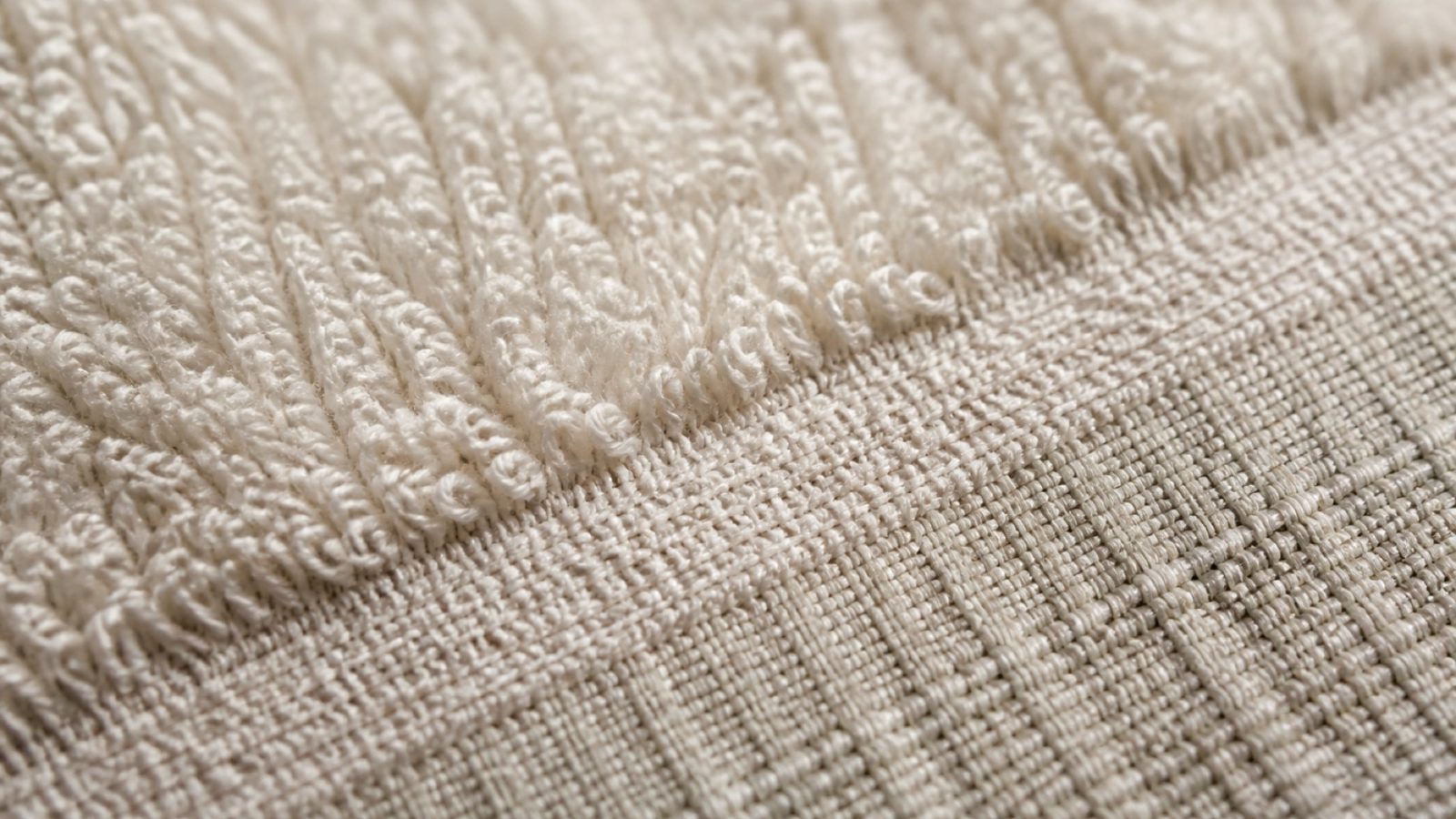
Terry is a looped pile. The loops give an enormous surface area, which is why terry absorbs more than any other weave, and also why it is the slowest to dry. It is the right choice for bath towels.
Waffle is a flat honeycomb. It holds far less water and hangs dry in a few hours. That makes it a poor bath towel and an excellent robe, and a good choice in a humid bathroom or a hot climate.
Ribbed and flat weaves have almost no pile. They are dense, hard-wearing and fast to dry, which is why bath mats are made this way rather than as a tufted rug.
The fibre, briefly
Long-staple cotton means the individual fibres are longer, so the yarn has fewer loose ends. That is most of the reason one towel sheds lint for a month and another stops after two washes. It also allows a lower twist in the yarn, which lets the loops open up in the wash and absorb more over the first month rather than less.
What to expect in the first month
A new towel is water-repellent. There is a finish left from the loom, and it takes one wash to remove it. This is why a brand new towel seems to work badly. It will also shed lint for two or three washes, and it will shrink, mostly in length. Every finished size on this site is the size after that has happened.
The one thing that ruins towels
Fabric softener. It works by depositing a thin waxy film on fibres, which is exactly the wrong thing to do to a cloth whose job is to take up water. Half a dose of ordinary detergent and no softener at all will keep a towel absorbing for years. If your towels have stopped working, a hot wash with no detergent and a cup of white vinegar will strip most of the build-up out.