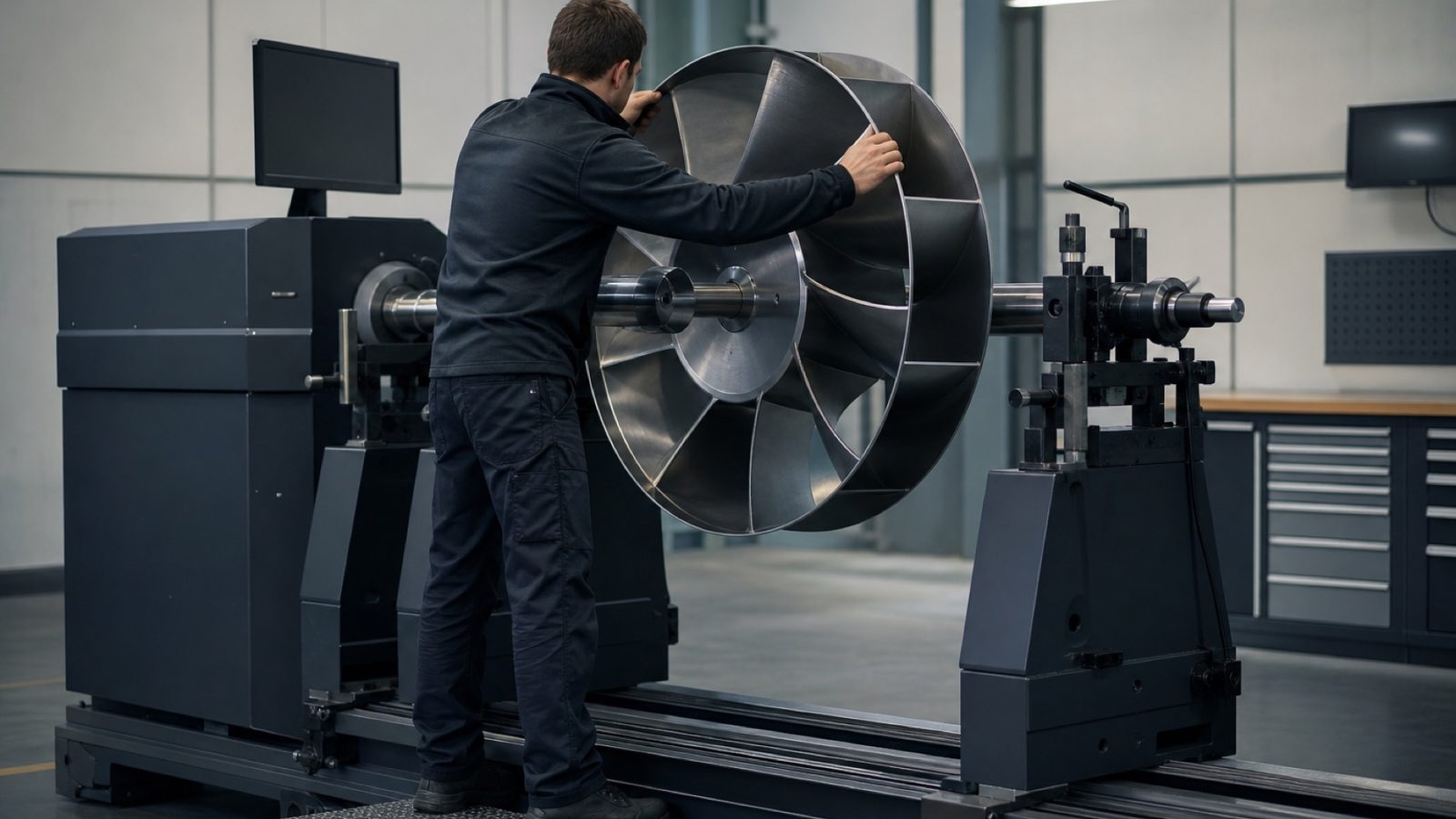
An impeller that is out of balance does not usually announce itself. It runs, it moves air, and it quietly destroys bearings, loosens fixings and puts vibration into the structure it is bolted to. By the time someone notices, the cost is a shutdown rather than a balancing job.
What a balancing grade actually says
ISO 21940-11 defines balance quality grades: G6.3, G2.5, G1 and so on. The number is the product of the specific residual unbalance and the angular velocity, expressed in millimetres per second. In practice it sets how much residual unbalance is permitted per unit of rotor mass at the operating speed.
Two consequences follow, and both are frequently missed. First, the permitted unbalance scales with rotor mass, so a big impeller is allowed more absolute unbalance than a small one at the same grade. Second, it scales inversely with speed: the same physical unbalance that is acceptable at 900 rpm is not acceptable at 2 900 rpm. A grade quoted without the speed it applies to is incomplete.
Which grade for which fan
G6.3 is the common industrial default for fans and is appropriate for most ducted units on a stiff structural base. G2.5 belongs on fans running at higher speed, on fans mounted on a lightweight roof or a steel frame that will transmit vibration, and on anything installed above or beside occupied space. Going finer than the application needs costs balancing time and buys nothing.
Why one plane is not enough
A wide impeller has mass distributed along its axis, so unbalance can exist as a couple as well as a static offset. Correcting in one plane fixes the static component and can leave the couple untouched, which shows up as a rocking motion the bearings feel even though the wheel passes a single-plane check. Any impeller whose width is significant relative to its diameter should be balanced in two planes.
What unbalance costs
The force from an unbalanced rotor rises with the square of the speed, so a modest unbalance at low speed becomes a serious cyclic load when the same wheel runs faster. That load is carried by the bearings on every revolution. Bearing life falls steeply with load, so a fan running with elevated vibration is consuming bearing life at a rate that has nothing to do with how many hours it has run.
Downstream of that: fixings work loose, welds at the blade root see reversing stress, shaft seals wear unevenly and start to leak, and the vibration transmits into whatever the fan is mounted on. On a roof unit that means a complaint from the floor below. On a process fan it means unplanned downtime in the middle of a production run.
Balance is not permanent
A fan that left the works in balance will not stay there. Dust builds unevenly on blades, erosion removes material unevenly, and a single blade repair changes the distribution. Any of these can take a wheel outside its original grade without anything visibly failing.
The practical answer is a periodic vibration reading at the bearing housings, recorded and trended. A single reading tells you very little; a trend tells you whether the wheel is drifting and roughly how fast. Where a fan is critical, specify accelerometer mounting pads on the bearing housings at order, because retrofitting them to an installed fan is a much larger job than it sounds.
What to ask for at purchase
Ask which grade the impeller was balanced to, at which speed, in how many planes, and ask for the balancing report filed against the serial number. If a supplier cannot produce that document, the wheel was probably checked rather than balanced.