26 August 2026
Why 0.021 °C/W matters more than your flow rate
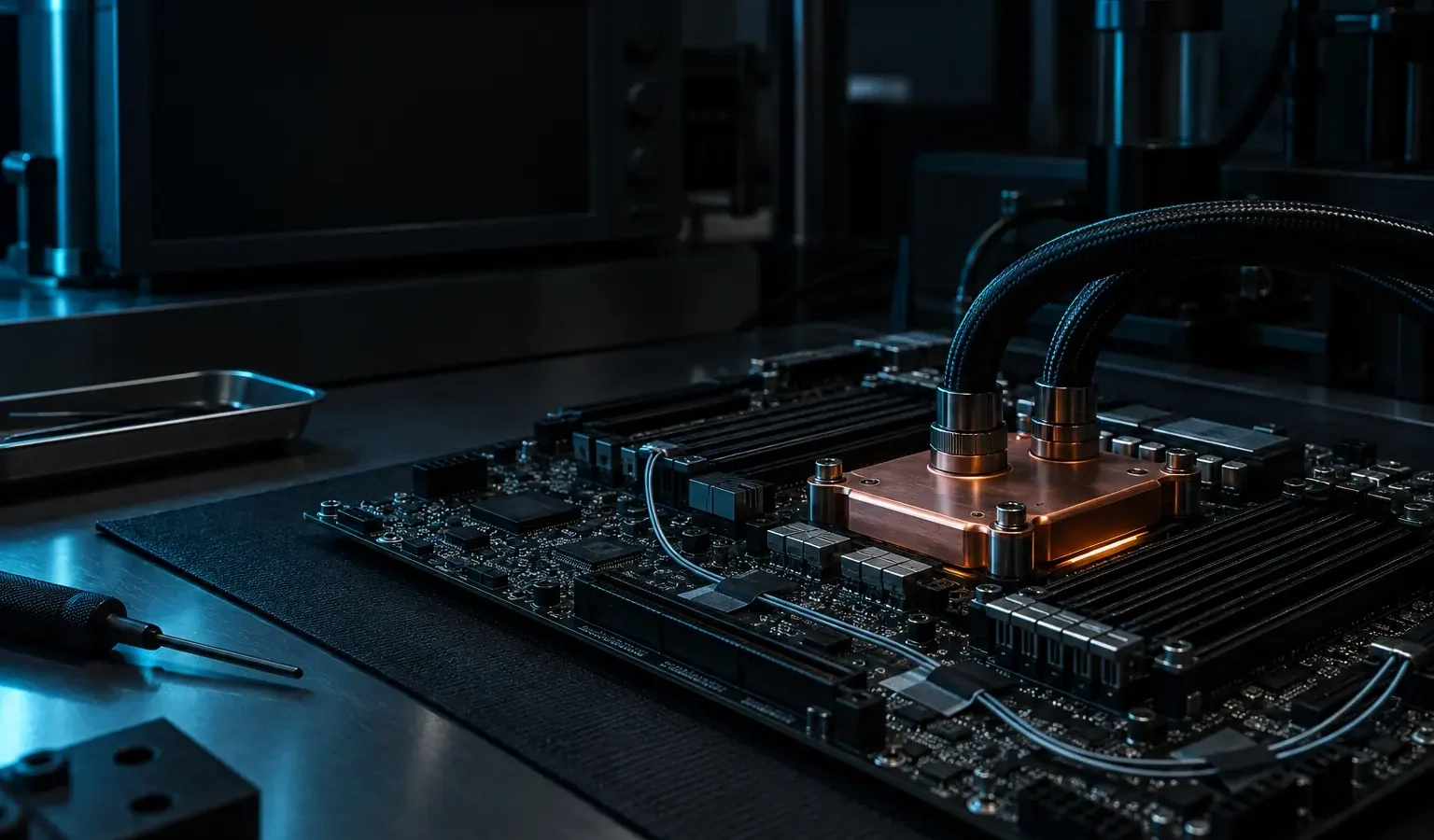
Ask most buyers what they want from a cold plate and the answer comes back as a flow rate. It is the wrong question, and it is the wrong question in a way that costs money for the whole life of the deployment.
The number that sets junction temperature
Thermal resistance from die to fluid, R th, is what converts watts into degrees. A package dissipating 1,600 W through a plate at 0.021 °C/W sits about 34 K above the fluid that is touching it. Change the plate to 0.030 °C/W and that becomes 48 K — fourteen degrees of junction temperature, bought or lost, before you have touched the pump.
Flow rate does move R th, but with sharply diminishing returns. Doubling flow through a well-designed microchannel plate might buy you eight to twelve per cent in thermal resistance. It will cost you roughly four times the pressure drop, because pressure loss rises with the square of velocity.
Where the money goes
Pumping power scales with flow multiplied by pressure drop, so that same doubling costs about eight times the hydraulic power. In a 40-rack hall that is not a rounding error; it is a line on the operating budget that persists for a decade.
The useful way to read a datasheet is therefore not "what is the best number this plate can reach" but "what is this plate's thermal resistance at the flow my facility can actually deliver, in August, with the filters half-loaded".
What to ask for instead
Ask for the curve. R th and pressure drop plotted across the whole usable flow range, with the inlet temperature and fluid mix stated. Ask what the number was measured on: a calibrated thermal test vehicle, or a simulation. Ask what bond line the measurement assumed.
A vendor who answers those three questions quickly is a vendor who has done the work.