A load rating is a claim about the future. It is only worth anything if you know how it was produced and what happens when the part does not meet it. This page sets out both.
Qualification testing
Every new product is tested to failure in our own facility during qualification. We record the failure load and the failure mode: a part that reaches a good number but fails in the wrong place goes back to the drawing board. The published minimum breaking load is set below the lowest band of those test results, so ninety-five percent of tested parts exceeded it.
Working load limit
Working load limit is minimum breaking load divided by a safety factor of 4.8 across all rated rigging components. The factor covers shock loading, fatigue, off-axis loading and in-service wear – not uncertainty about the test result.

Production control
- Proof loading. 100 percent of rated components are proof loaded to twice their working load limit before dispatch.
- Batch sampling. Destructive samples are pulled from each production batch and compared against the qualification data.
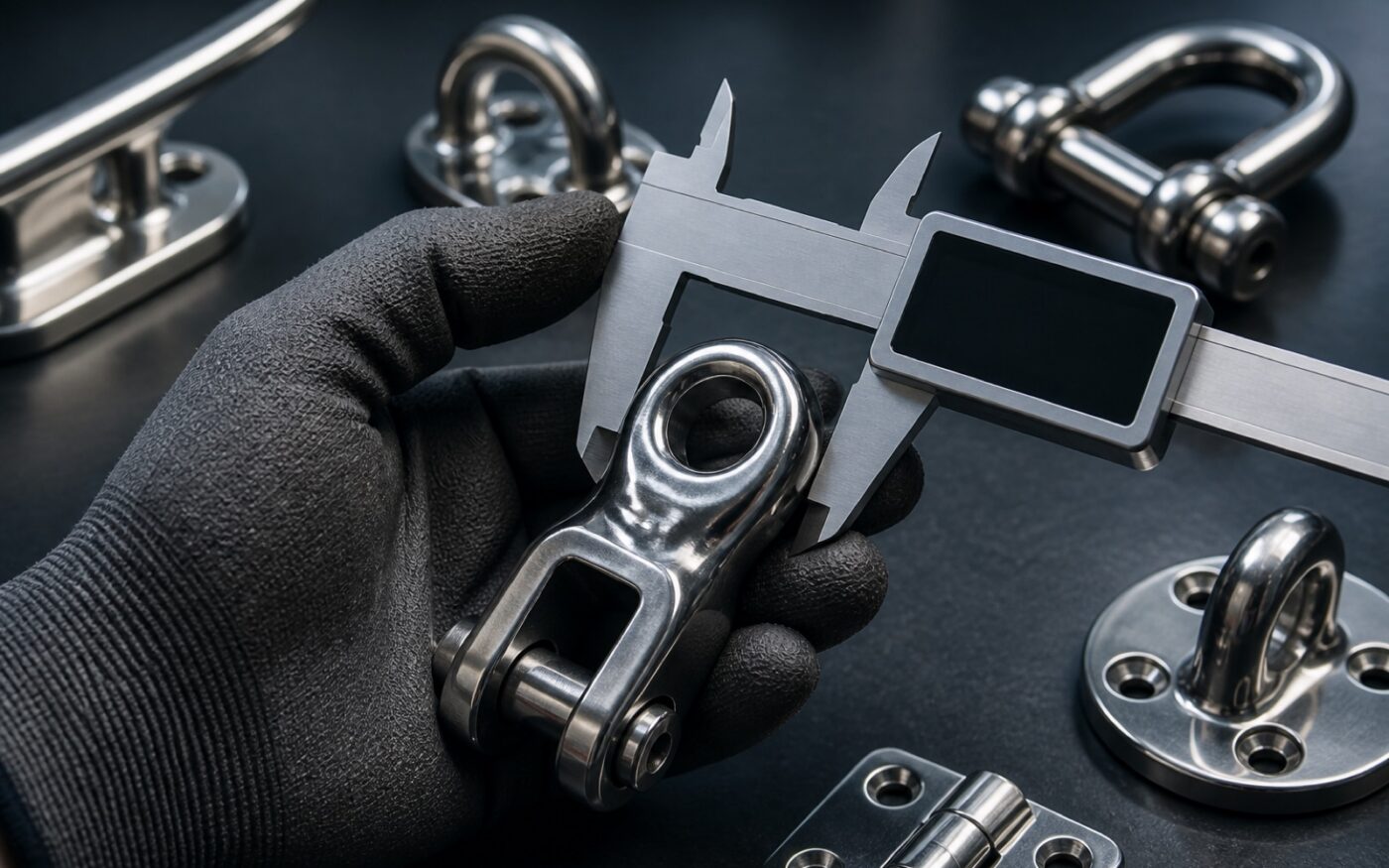
- Dimensional inspection. First-article plus in-process checks against the controlled drawing.
- Salt spray. Every new finish is qualified with a 1,000-hour salt spray corrosion test before it reaches a catalogue page.
Documentation
| Material certificate | Full mill certificate, matched to heat number, supplied on request |
|---|---|
| Proof load record | Batch record as standard; individual records available for survey work |
| Batch code | Stamped on every rated fitting |
| Quality system | Documented and internally audited annually, aligned to ISO 9001 |
| Record retention | Ten years from date of dispatch |
| Drawings and 3D models | Supplied on request for catalogue products |
If something fails
Send us the part, not a photograph of the boat. We will section it, examine the failure surface and tell you what we find, including when the answer is that the fitting was undersized, badly installed or simply worn out. That report goes to you whether or not it favours us, because a failure we do not understand is a failure we will repeat.