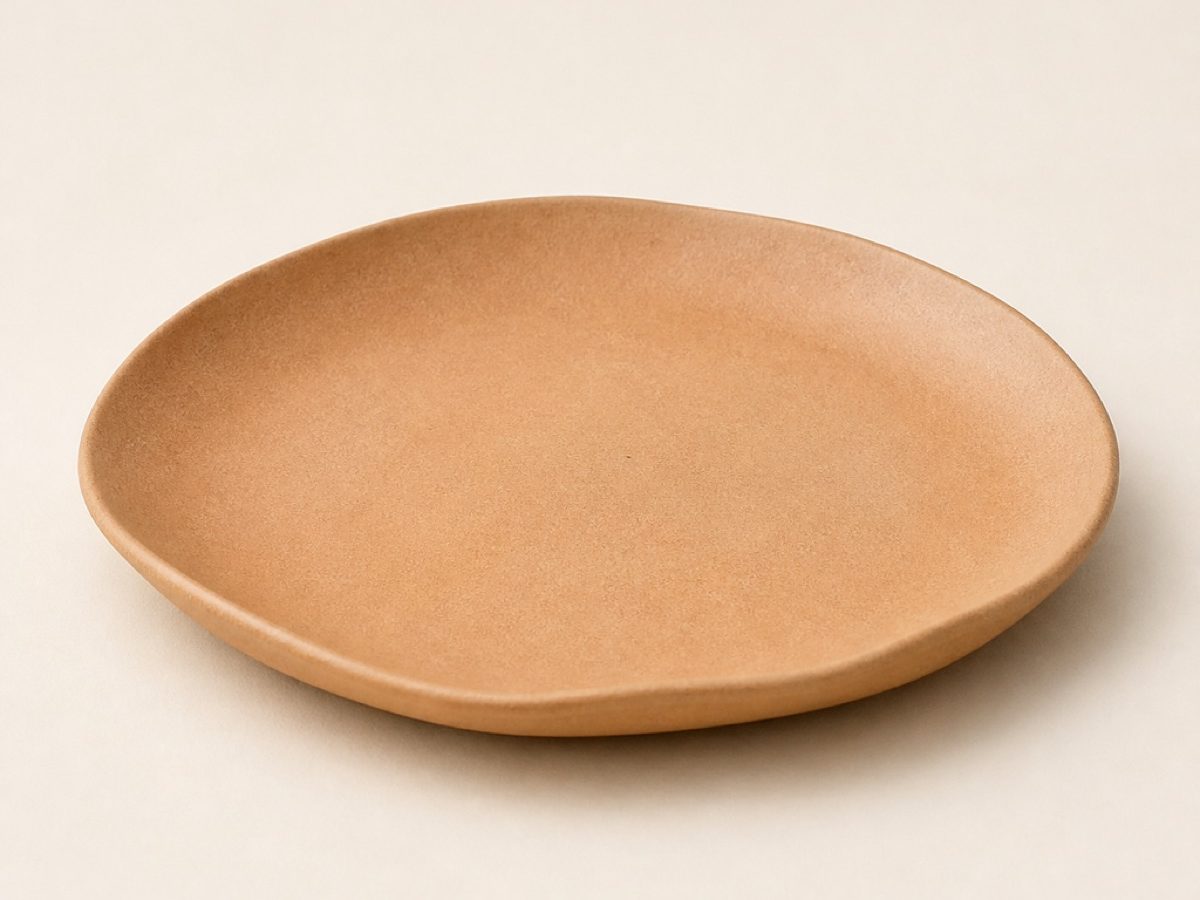
The three words get used as though they described styles. They do not. They describe firing temperatures, and everything else follows from that one number.
Earthenware
Fired lowest, roughly 1,000 to 1,150 °C. The clay body never vitrifies, so it stays porous. Chip the glaze and the body underneath will absorb water. Earthenware is light, it takes bright colours well because low temperatures do not burn pigments out, and it is the cheapest of the three to produce.
The costs are real. A porous body behind a crazed glaze will stain, hold odours and eventually weep. Earthenware also chips more readily, because the body is softer than the glaze sitting on it.
Stoneware
Fired around 1,200 to 1,300 °C, which is hot enough that the body vitrifies and stops absorbing water. It is heavier than porcelain at the same wall thickness, opaque, and hard enough to take daily dishwasher use for years.
Vitrification is why crazing does not matter much on stoneware. The lines are in the glaze and there is no absorbent body behind them. It is also why stoneware handles heat more reliably than earthenware: a vitrified body is more consistent, so it expands more evenly.
Porcelain
Fired highest, 1,300 °C and up, from a whiter and finer clay. Vitrified, translucent when thin, and the strongest of the three per millimetre of wall. That strength is what allows porcelain to be made thin, and thinness is why it feels light and precise in the hand.
The trade-off is that thin walls chip at the rim, and a chip in white porcelain is far more visible than a chip in a dark stoneware glaze. Porcelain also moves heat quickly, so tea in a thin porcelain cup is hotter to hold and cools faster.
Choosing for daily use
For a table used every day and emptied into a dishwasher every day, stoneware is the practical answer. It is vitrified so it will not stain, thick enough at the rim that an ordinary knock will not chip it, heavy enough not to slide on a table, and dark enough that the marks it does collect do not announce themselves.
Porcelain is the better answer when weight is a real constraint: a household where someone carries a loaded tray, or a cupboard high enough that lifting six stoneware plates down is a genuine consideration. It is also the better answer if you want the plate to disappear under the food.
Earthenware earns its place where colour is the point, on hand-painted pieces and serving dishes that live on a shelf. It is a poor choice for a plate that will be washed three hundred times a year.
What to check on a product page
The word on its own is not enough, because “stoneware” gets used loosely by people selling earthenware. Look for a stated firing temperature or the word vitrified, a weight per piece, and an explicit dishwasher statement. A page that gives you none of those three is describing a look, not a material, and you are buying on the photograph.