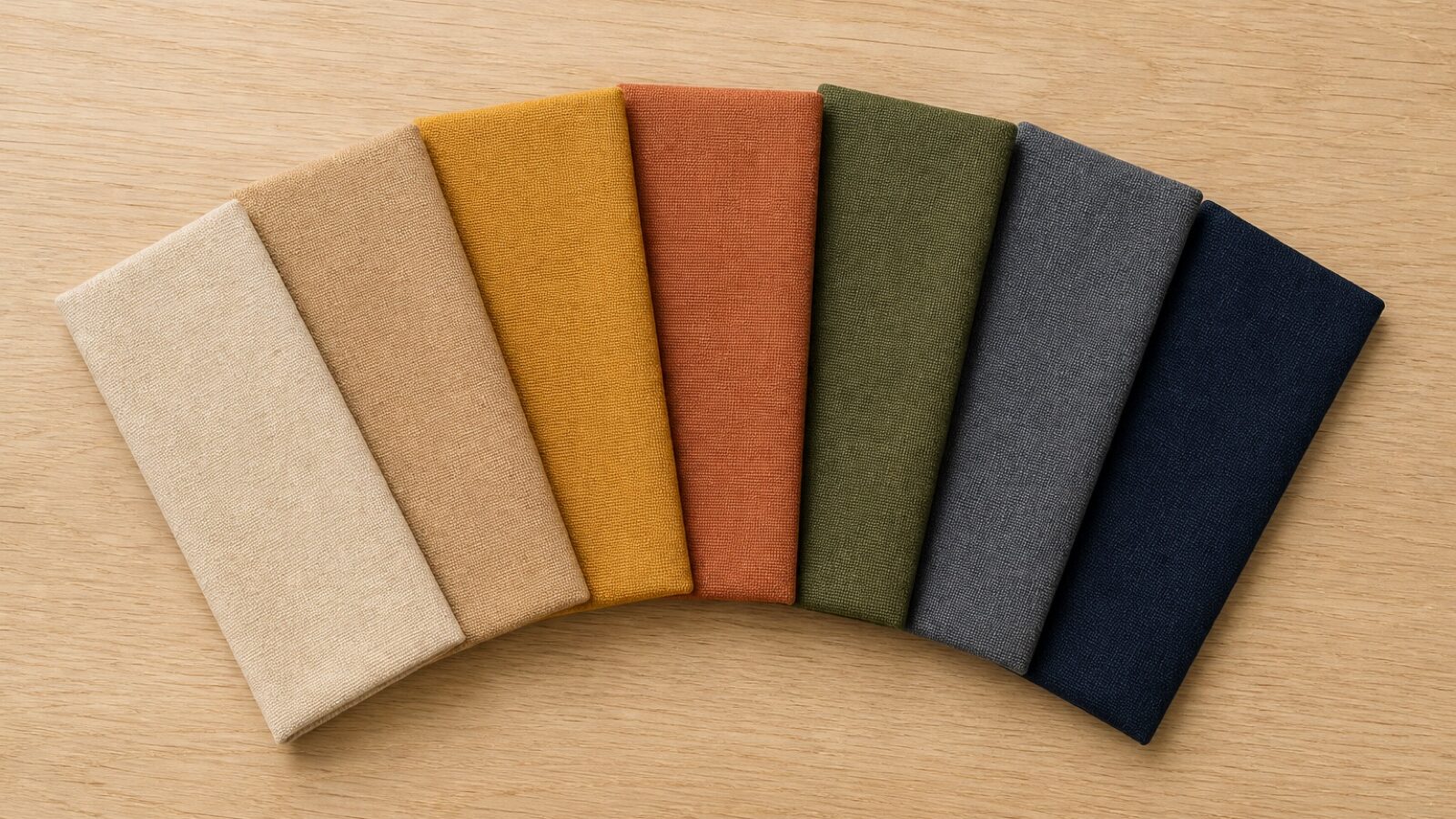
A room falls apart when every colour in it is applying for the same job. The fix is not better taste, it is a hierarchy: one colour leads, one supports, one interrupts, and the walls stay out of the argument entirely.
Sixty, thirty, ten
Sixty per cent of the colour in a room should be on one object — usually the sofa or the bed, because they are the largest upholstered thing in the space. Thirty per cent supports it: curtains, an armchair, the ground of a rug. Ten per cent interrupts: cushions, a footstool, a lampshade. That is the whole rule and it is the one we never let a customer talk us out of.
Where the support colour comes from
Roughly a third of a turn around the colour wheel from the lead — we use thirty-two degrees — in whichever direction lands nearest a cloth we actually weave. It also has to differ from the lead by at least twelve points of lightness, or the two blur into one another across a room and you have spent money on a difference nobody can see.
Where the accent comes from
Not the straight opposite. A true complement of a muted earth tone reads as a mistake, like something arrived from a different house. We go to a hundred and sixty-eight degrees instead — a split complement — and insist the result carries at least fifteen per cent saturation. Below that it stops looking like a decision and starts looking like dirt.
When your favourite colour cannot lead
Moss, Slate and Ink all sit below twenty per cent saturation. They are wonderful cloths and they cannot carry a room on their own; put a moss sofa in a moss-adjacent room and the whole thing goes flat. So the board flips: the quiet colour becomes the ground the room stands on, and the accent is drawn from the loudest cloth in the library rather than from the wheel. Moss lead, oatmeal support, ochre accent. It works every time.
The walls do nothing
Chalk, or something within a shade of it, unless the lead itself is very pale — then the ground has to drop to a quiet dark so the room keeps some floor under it. Walls that participate in a scheme are walls that will annoy you by the second winter.
Leave a Reply