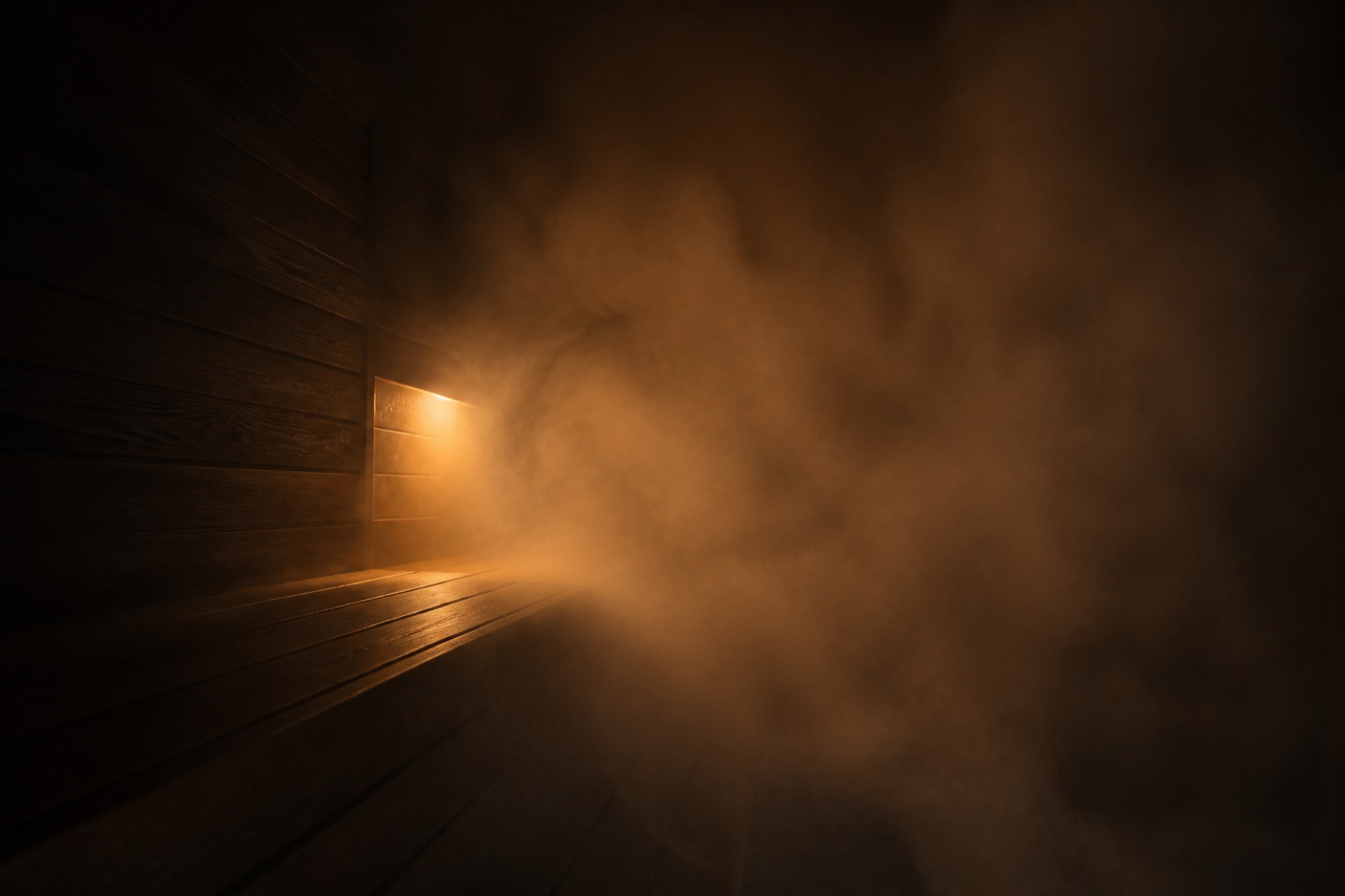
A sauna is a thermal machine wrapped in timber. Both halves need the same rigour, and most of the failures we are called in to fix come from treating the timber half as decoration.
Thermally modified aspen
Our default for every surface a bather touches. Aspen is heat-treated at 190 to 212 °C in a controlled, oxygen-poor atmosphere. The process drives out extractives, drops equilibrium moisture content to 6–8 % and collapses the hemicellulose that would otherwise feed decay.
What that buys you: benches that do not cup after the first season, no resin blisters at bench height, and a surface comfortable against bare skin at 95 °C with no coating of any kind.
Nordic spruce
Structure, framing and exterior cladding. Slow-grown, straight-grained and stable once kiln-dried to 12 %. Our barrel shells are machined from 42 mm spruce staves on a four-sided moulder so the tongue-and-groove joint stays tight through seasonal movement.
Western red cedar
Specified where the client wants the aroma and accepts that cedar is softer and marks more easily than thermo-aspen. It suits infrared cabins particularly well, because operating temperatures of 40 to 65 °C never test its softness.
Blackened steel
Bench carriers, band sets, door furniture and heater guards. Powder-coated matte black over zinc-rich primer for interior work; 316 stainless for anything exposed to weather or to a wet-heat environment.
The vapour barrier
The least visible and most important component in an indoor sauna. Aluminium-faced membrane, lapped 100 mm at every joint and taped, held off the lining by a 12 mm batten cavity so any moisture that does get past has a drainage path. Get this wrong and the cabin rots from inside within five years, whatever the timber.
How it is built
- CNC machining. Wall, ceiling and bench components cut to ±0.5 mm before assembly.
- Dry assembly. Every cabin is fully built on our floor and checked before anything is packed.
- Numbered flat pack. Panels labelled against the drawing set, fixings pre-sorted by assembly stage.
- Test firing. Heaters and controllers are run up and logged before they leave the works.