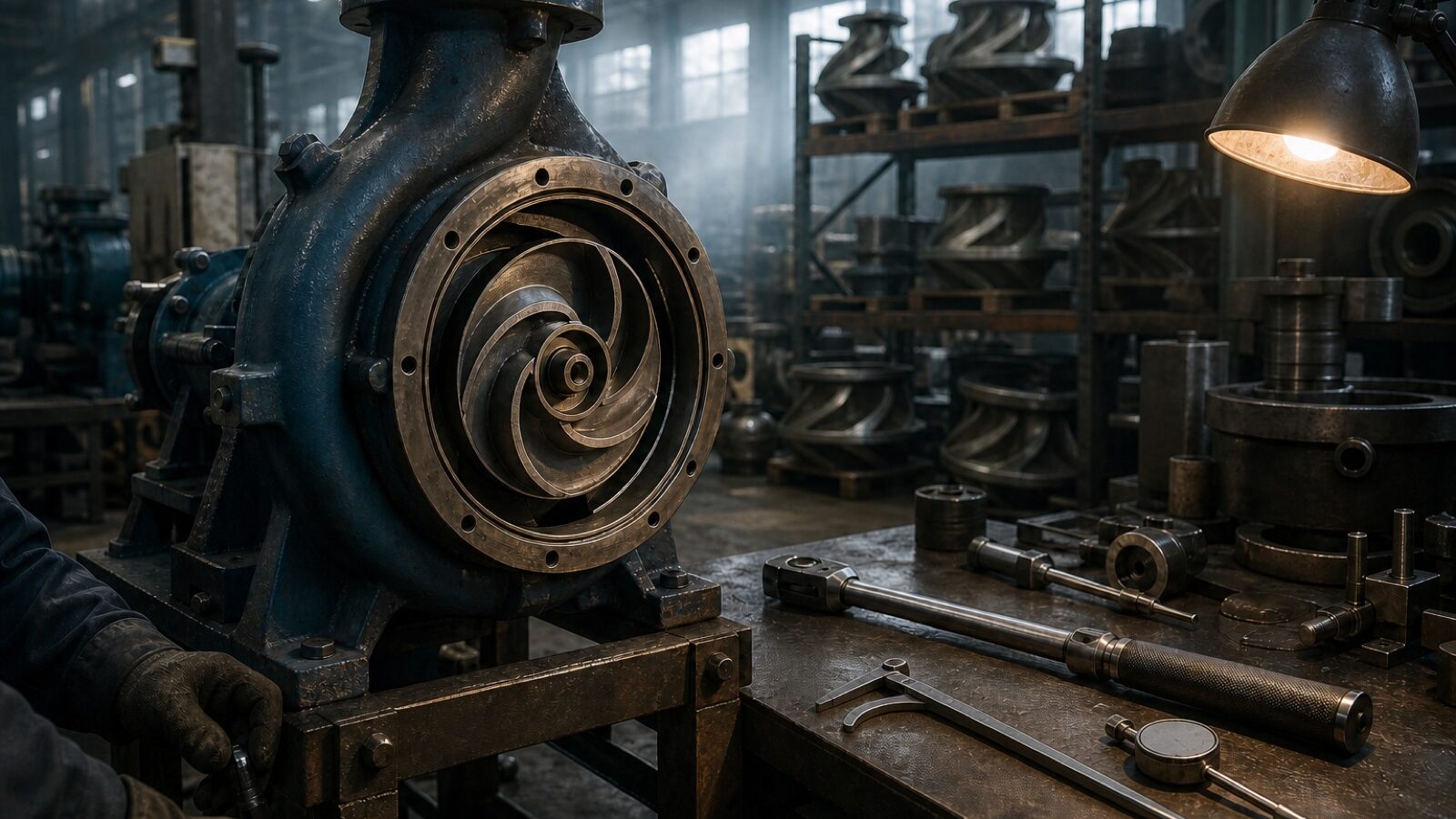
Almost every pitted impeller we are sent has the same story attached: the pump was fine for a while, then it started rattling, then the vanes went honeycombed. The pump did not change. The suction condition did — or it was marginal from the first day and nobody had the number.
Two numbers, one comparison
NPSH required (NPSHr) is a property of the pump. It is measured on a test rig and it rises steeply with flow. NPSH available (NPSHa) is a property of your installation. It is the absolute pressure at the suction flange, minus the vapour pressure of the liquid at its actual temperature, expressed in metres of that liquid.
The rule is simple and unforgiving: NPSHa must exceed NPSHr, with margin, at every flow the pump will ever see — not just at the rated point.
What eats the available margin
- Temperature. Water at 20 °C has a vapour pressure of 0.24 m. At 80 °C it is 4.8 m. The same suction line loses four and a half metres of margin on a hot day in a closed loop.
- Altitude. Atmospheric pressure at 2 000 m is roughly 8.0 m of water instead of 10.3 m. Mine sites lose margin before the pipework is even drawn.
- Suction friction. A long, undersized suction line with a foot valve and two elbows can eat a metre on its own, and it eats more as flow rises — exactly when NPSHr is rising too.
- Strainers. A clean strainer costs a little. A half-blocked one costs a lot, and nothing on the control panel tells you it has happened.
Practical margin
A 0.5 m margin on paper is not a margin. For clean cold water in a stable system, aim for at least 1 m or 1.3 × NPSHr, whichever is greater. For hot liquids, volatile hydrocarbons, or duties that swing widely, take more. For a suction lift, remember that NPSHa falls as the sump level falls: run the calculation at the lowest level the controls actually permit, not the average one.
When the number will not work
If NPSHa cannot be raised, the pump has to change. Options in rough order of cost: a larger suction eye or a low-NPSH first-stage impeller; a slower speed, since NPSHr falls roughly with the square of speed; an inducer ahead of the impeller; or a vertical turbine or submersible arrangement that puts the impeller below the liquid level and removes the problem instead of managing it.
Send us the fluid, its temperature, the suction geometry and the site altitude, and we will run NPSHa against the curve for you before you commit to a pump type.