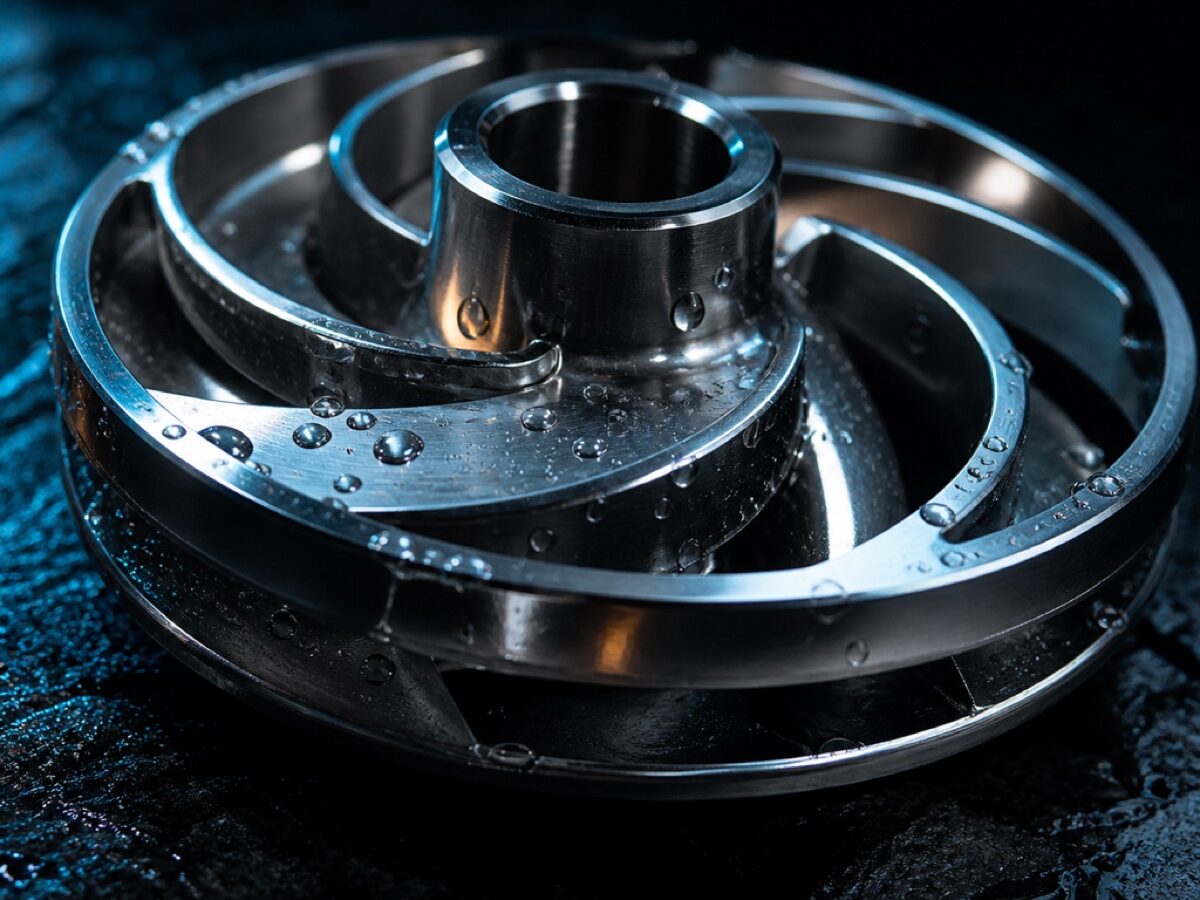
The safest-looking decision in a pump specification is to add margin. The calculated head comes out at 82 metres, so 95 is ordered; the flow is 900 m³/h, so 1 100 is ordered. Nothing about that feels risky. It is, though, and the cost turns up two years later in the maintenance budget rather than in the purchase order.
What margin actually does to the duty point
A centrifugal pump does not choose its operating point. The intersection of its head curve and the system curve does. Give the pump more head capability than the system needs and the intersection moves left, toward shut-off, into the part of the curve where the hydraulics were never intended to run continuously.
Left of the best-efficiency point the flow through the impeller stops following the vane profile. It recirculates at the eye and at the discharge tips, and that recirculation is not gentle: it is a rotating stall that loads the impeller unevenly once per revolution.
Where the damage shows up
- Radial load. A single-volute casing is only hydraulically balanced near the best-efficiency point. At 50% of BEP flow the radial thrust can be several times the design value, and it is the shaft and the bearings that carry it.
- Shaft deflection. More radial load means more deflection at the seal faces. A mechanical seal that was specified for 0.05 mm of runout does not last long at three times that.
- Cavitation at part load. Suction recirculation produces localised low-pressure zones inside the eye even when the calculated NPSH margin looks generous. The pitting appears on the underside of the vanes near the leading edge, which is exactly where nobody looks first.
- Wasted power. Running at 65% efficiency instead of 86% on a 90 kW motor is roughly 22 kW you pay for continuously and never use.
The better way to build in margin
Margin belongs in the impeller diameter, not in the model selection. Pick the casing whose full-diameter curve comfortably covers the duty, then trim the impeller so the duty point sits at or just right of the best-efficiency point. If the system turns out to need more head later, the same casing takes a larger impeller — a part, not a new pump.
Where the duty genuinely varies, a variable-speed drive moves the whole curve rather than throttling against a fixed one. Affinity laws are kind here: dropping speed to 80% drops absorbed power to roughly half.
Send us the flow, the head, the fluid and the range the plant actually operates across, and we will show you where the duty point lands on the curve before anything is quoted.