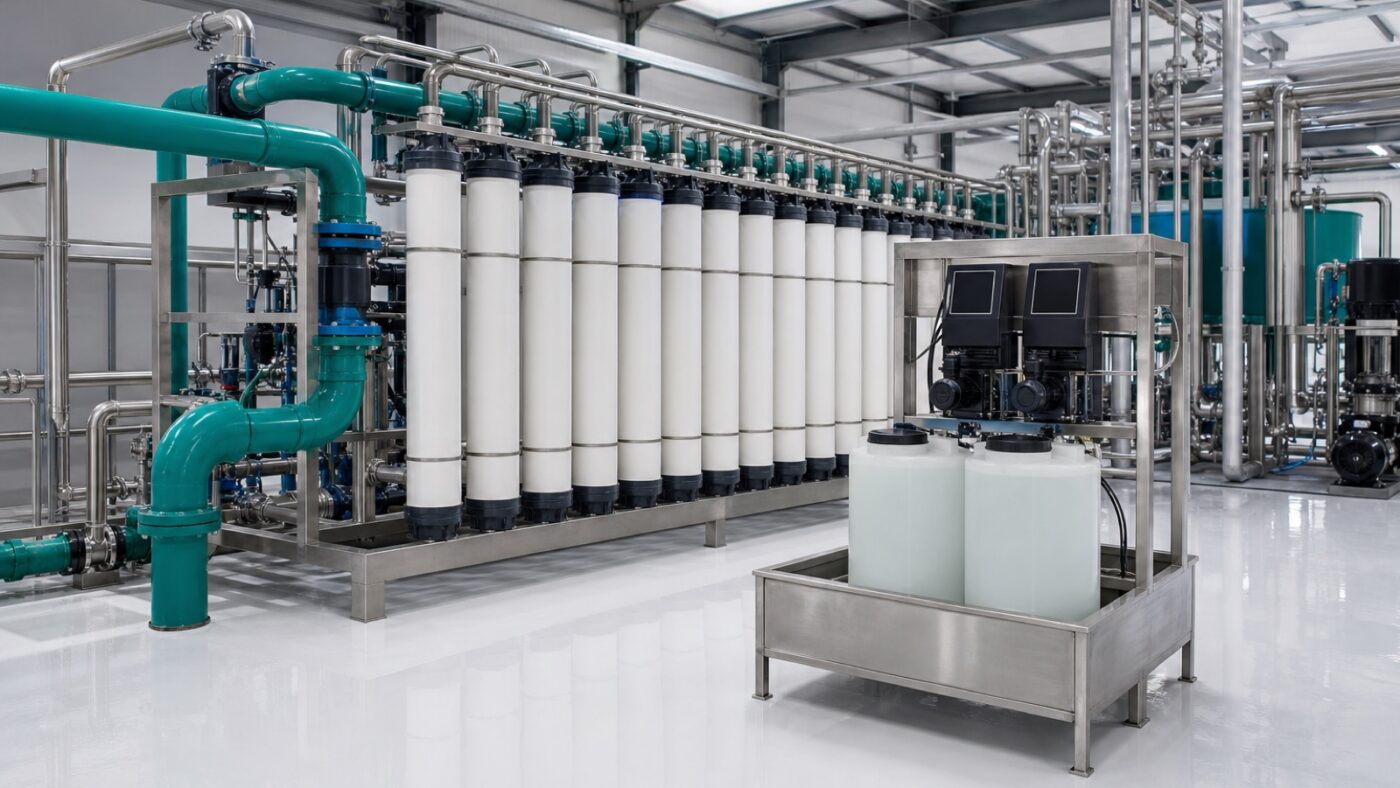
Clearflow NF-SD 300
Nanofiltration softening train removing hardness, sulphate and colour without full demineralisation.
Where the problem is hardness, sulphate or colour rather than salinity, nanofiltration takes out what matters and leaves the rest — at roughly half the operating pressure of a reverse osmosis train on the same water.
What it is designed to do
The Clearflow NF-SD 300 is a standard Clearflow configuration rated at 30 m³/h of permeate at 75 % system recovery, which is 720 m³ over a continuous day. The published envelope assumes 25 °C, a clean membrane and the design feed analysis; every project is re-projected against the water you actually have before a price is issued.
- Feed envelope — up to 2,500 mg/L TDS, SDI15 below 4, turbidity below 0.5 NTU
- Membrane hardware — 36 elements across 6 vessels, 1,339 m² of active area
- Energy — 0.61 kWh/m³ of product at design conditions, 15 kW installed motor load
- Delivery — 5.4 × 1.8 × 2.4 m, 2,650 kg dry, 10–12 weeks ex works
How the array is put together
The array is arranged as 2 stage, 4:2 taper, 6 elements per vessel. Element type is NF 8040 softening element, 37.2 m² each, running on piperazine-based polyamide nanofiltration, >97 % divalent rejection. Design flux is held at 22.4 LMH so the concentrate velocity through the last element stays inside the manufacturer envelope at design recovery — the single most reliable predictor of how long the membranes will last.
Operating conditions
| Parameter | Design value | Note |
|---|---|---|
| Feed pressure | 11.8 bar | At design feed TDS and 25 °C |
| Trans-membrane differential | 1.20 bar | Clean; change-out trigger at twice this value |
| Feed temperature | 5–40 °C | Output falls roughly 3 % per °C below 25 °C |
| Continuous pH | 3.0–10.0 | Wider band tolerated during cleaning |
| Free chlorine | Max 0.10 mg/L | Continuous exposure limit at the membrane face |
| Concentrate flow | 10.0 m³/h | At design recovery |
Cleaning, control and materials
Two-stage CIP, 1,000 L heated tank. Control is by Industrial PLC with a 7 in HMI and hardness breakthrough alarm. The wetted specification is 316L wetted parts, FRP pressure vessels. Pressurisation is by vertical multistage 316L on a variable frequency drive; not required at nanofiltration pressures.
CF-NF-SD300 data sheet
| Permeate capacity | 30 m³/h |
|---|---|
| Daily output at 24 h | 720 m³/d |
| System recovery | 75 % |
| Design feed flow | 40 m³/h |
| Concentrate flow | 10 m³/h |
| Nominal rejection | 92.00 % |
|---|---|
| Typical permeate TDS | 369.6 mg/L |
| Design flux | 22.4 LMH |
| Feed pressure | 11.8 bar |
| Trans-membrane ΔP | 1.20 bar |
| Specific energy | 0.61 kWh/m³ |
| Max feed TDS | 2,500 mg/L |
|---|---|
| Min design feed TDS | 200 mg/L |
| Max feed SDI15 | 4.0 |
| Max feed turbidity | 0.50 NTU |
| Min feed temperature | 5 °C |
| Max feed temperature | 40 °C |
| Min continuous pH | 3.0 |
| Max continuous pH | 10.0 |
| Max free chlorine | 0.10 mg/L |
| Membrane elements | 36 pcs |
|---|---|
| Pressure vessels | 6 pcs |
| Elements per vessel | 6 pcs |
| Stage 1 vessels | 4 pcs |
| Stage 2 vessels | 2 pcs |
| Array configuration | 2 stage, 4:2 taper, 6 elements per vessel |
| Element type | NF 8040 softening element, 37.2 m² each |
| Membrane chemistry | Piperazine-based polyamide nanofiltration, >97 % divalent rejection |
| Active membrane area | 1,339 m² |
| Pressure pump | Vertical multistage 316L on a variable frequency drive |
|---|---|
| Energy recovery | Not required at nanofiltration pressures |
| Wetted materials | 316L wetted parts, FRP pressure vessels |
| Control system | Industrial PLC with a 7 in HMI and hardness breakthrough alarm |
| Cleaning regime | Two-stage CIP, 1,000 L heated tank |
| Skid footprint L×W×H | 5.4 × 1.8 × 2.4 m |
| Dry shipping weight | 2,650 kg |
| Installed motor load | 15 kW |
| Indicative lead time | 10–12 weeks ex works |
Request a projection for Clearflow NF-SD 300
Send us the feed analysis and duty flow and we will re-project this array against your water.