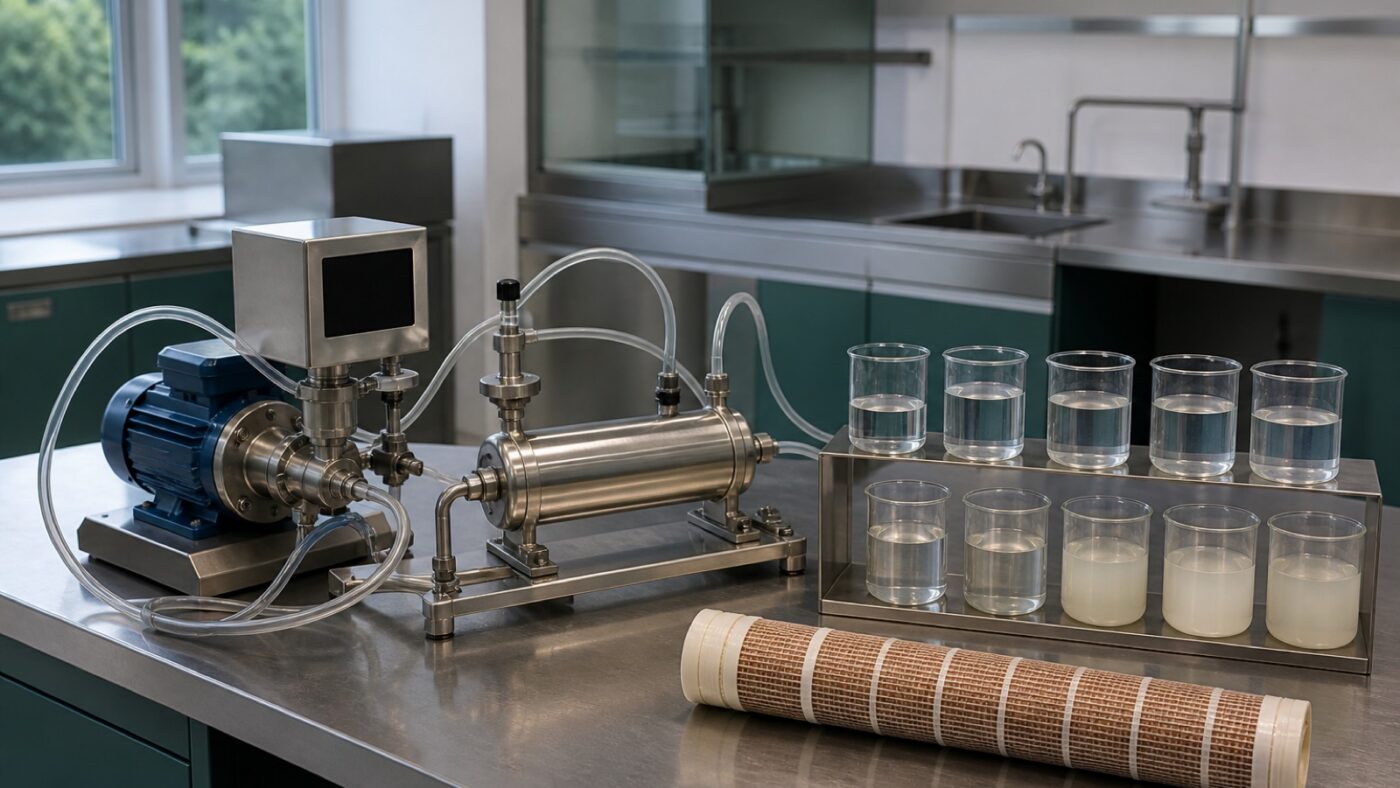
Nearly every water treatment specification includes a quick on-site cleanliness test for the incoming water. It takes twenty minutes, costs almost nothing and can be run by anyone — which is exactly why it is used everywhere, and also why it deserves a little less confidence than it usually gets.
What the quick test actually measures
The standard field test pushes water through a fine test filter and times how quickly the filter clogs. That gives a useful, repeatable snapshot — but it only sees the particles the test filter can catch. Some of the most troublesome material in real water is finer than that: it slips straight through the test, then settles on the treatment equipment over the following weeks. A water can pass the quick test comfortably and still cause fouling problems.
What gives a fuller picture
- Laboratory analysis — identifies what is actually in the water, not just how fast it clogs a filter
- Biological indicators — the best early warning for the kind of fouling the quick test cannot see at all
- A pilot trial — several days of testing on the real water, measuring the behaviour you will actually get
So why keep using the quick test?
Because it is fast, cheap and available at three in the morning. The better methods take days and a laboratory. The honest position is that the quick test is a poor absolute measure and a good relative one: if today’s reading has clearly moved from last week’s, something upstream has changed, and that is worth knowing immediately even if the absolute number means less than the specification implies.
How we handle it
We specify the quick test like everyone else, because contracts need a number that can be checked on site. We then design on the fuller laboratory picture — and where the water is unusual, on a measured trial — and we size the equipment with a multi-year margin, so that being wrong about the water is survivable rather than fatal.