Industrial Drive Systems
Engineering and Quality
Standards, materials, machining and the tests every unit goes through before it leaves the building.
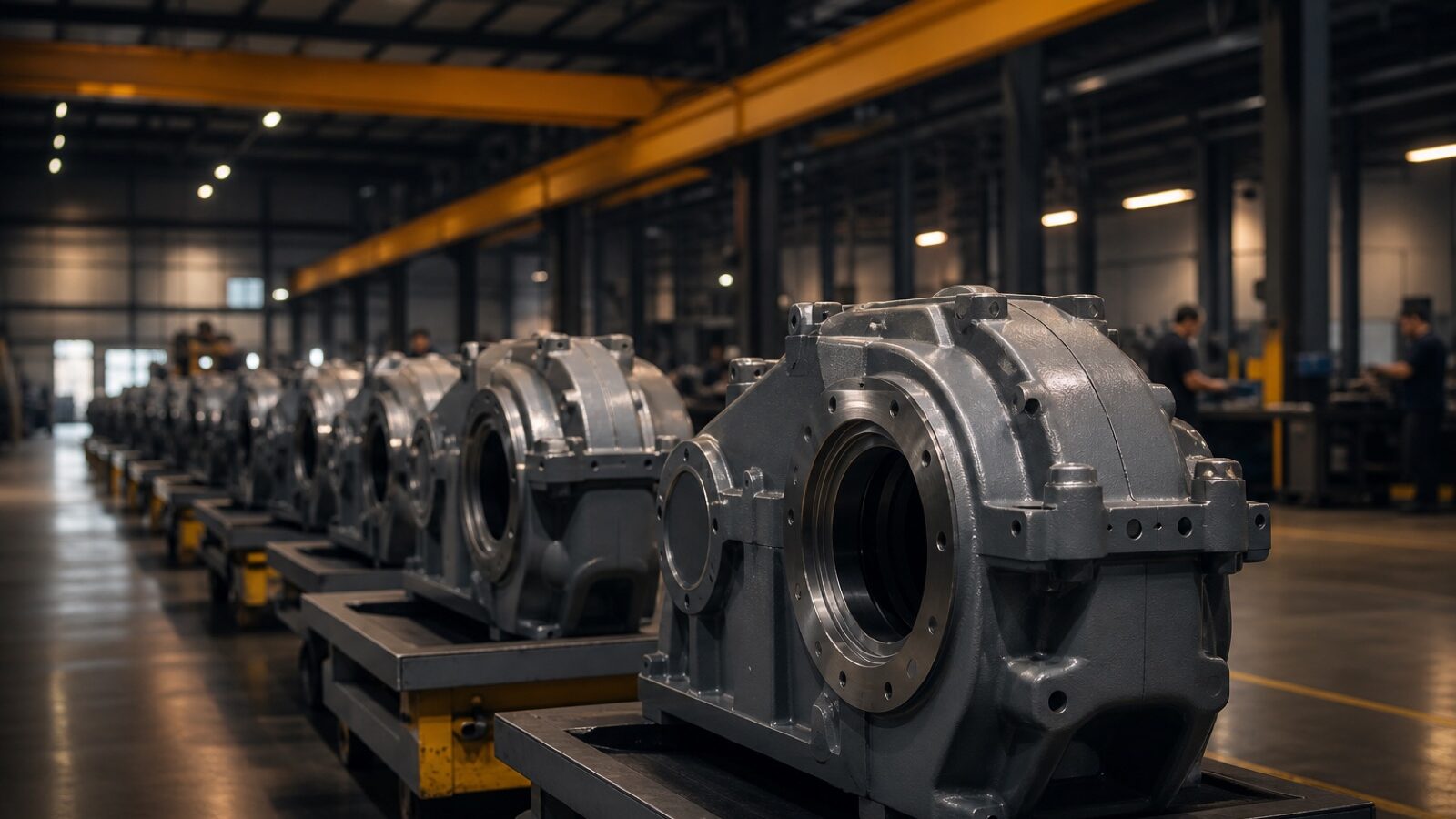
There is no clever secret to a gear unit that lasts twenty years. There is a tooth calculation done honestly, steel that is what the certificate says it is, heat treatment that is measured rather than assumed, and a test that is allowed to fail.
Rating standards
Every gear stage in every unit is rated to recognised international gear standards. We rate on the load pattern you give us, not on a single nominal figure, because a drive that spends part of its day well above nominal load is a completely different calculation from one that runs steadily all shift.
Materials
- Gears in case-hardened alloy steel, hardened and ground for a long, quiet service life.
- Housings in grey cast iron for the general range and nodular cast iron where mounting points see heavy repeated loading.
- Shafts in quenched and tempered alloy steel, with generous radii on the highly stressed steps.
- Worm wheels in centrifugally cast bronze on a steel hub, never solid bronze.
Manufacturing
Gears are cut soft, heat treated, then finish ground. The larger gears are precision ground after heat treatment, which is what lets a unit run noticeably quieter than a standard commercial gearbox. Bevel gear sets are lapped as matched pairs and stay together through assembly — they are marked, boxed and fitted as a pair, and a replacement is always supplied as a pair.
Housing bores are machined in one setting so the bearing seats stay perfectly in line. Mounting feet are machined flat across the whole bolt pattern, which matters more than most people expect: an uneven foot pulls the housing out of shape and puts the gear mesh out of contact before the machine has run an hour.
Test and documentation
- Run-in. Every unit runs unloaded in both directions while oil temperature and noise are logged.
- Loaded test. Production units are tested under full load on our own test bench before they ship.
- Contact pattern. Marking compound, load applied, pattern photographed. It goes in the file against the serial number and travels with the unit.
- Leak and seal check. Pressure held on the housing, seals inspected under a light, breather function confirmed in the delivered mounting position.
The test sheet ships in the crate. If a unit ever comes back, the first thing we do is pull its original test record and compare.
What we will tell you
If a frame is marginal, we will say so and quote the next one up alongside it. If the heat check fails, we will tell you the number and offer the cooling rather than bury it in a footnote. If a competitor’s frame is a better fit for a duty we cannot cover well, we will say that too. It is a smaller promise than it sounds, and it is the one customers remember.
Applications desk
Send us the duty, not the model number
Give us the required output torque, speed, load character and running hours. Our applications desk returns a sized unit, the service factor it achieves and a thermal check within one working day.