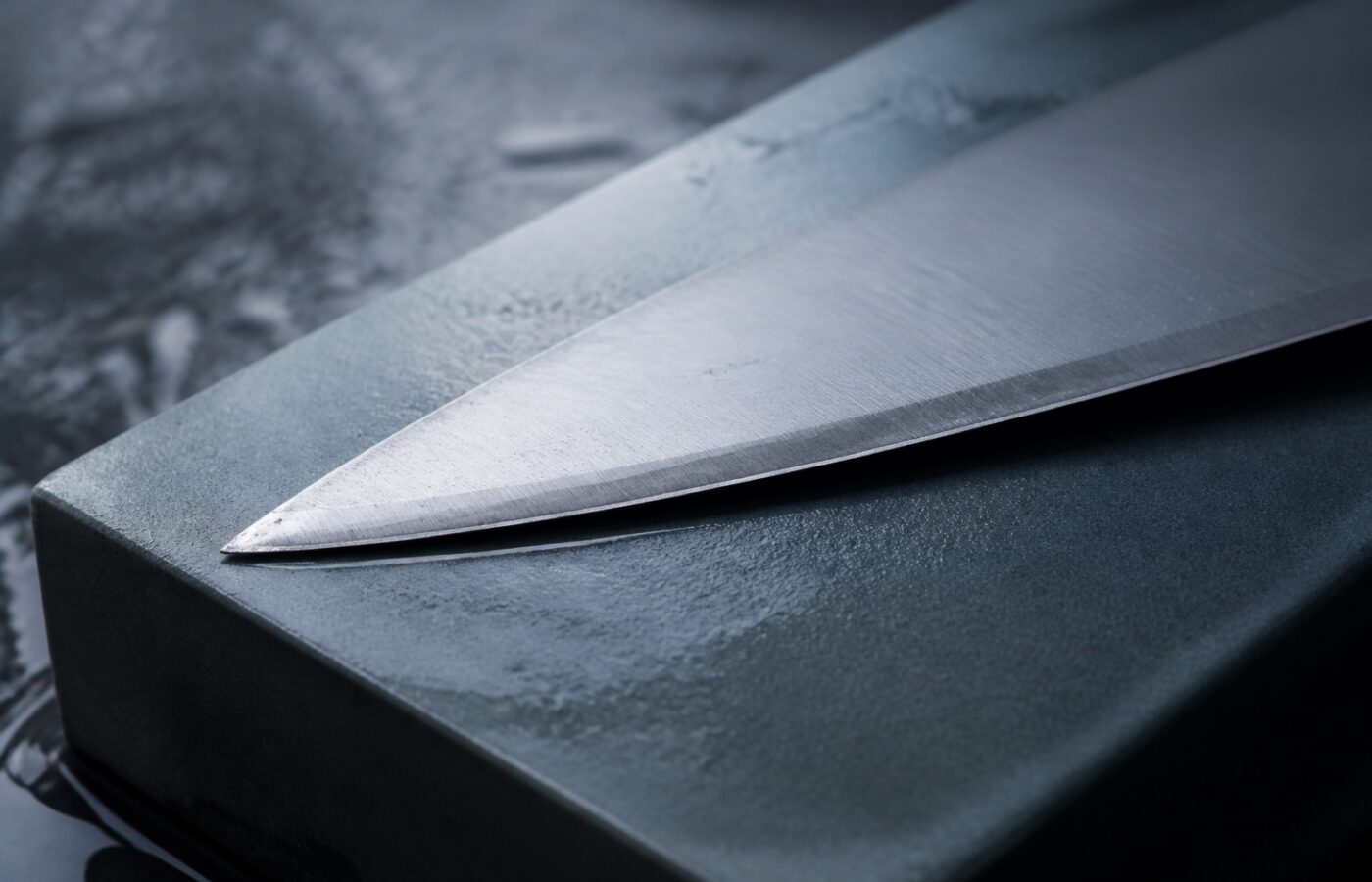
The question every new stone owner asks is the angle – and the honest answer is that consistency matters far more than the number. Here is the way we teach it at the Edge Lab bench, with no jigs and no mystique.
Start around 15 degrees per side
Most kitchen knives are happiest between 12 and 18 degrees per side: thin slicers at the low end, heavy western chef knives at the high end. If you remember one number, make it 15. A practical way to find it: rest the blade flat on the stone, lift the spine until a coin-and-a-bit would slide underneath, and you are close enough to begin.
Hold it, do not chase it
A wobbling 15 degrees produces a worse edge than a steady 18. Lock your wrist, move from the shoulders, and let the fingertips of your free hand press lightly where the edge meets the stone. Short, patient strokes beat long dramatic ones – the goal is the same angle on stroke fifty as on stroke one.
Feel for the burr
Work one side on the coarse stone until a fine wire of steel – the burr – forms along the whole opposite face. You can feel it dragging a thumb across (never along) the edge. The burr is the proof the two bevels have met; without it, more polishing only shines a dull edge.
Refine, strop, test
Switch to the fine side, halve your pressure, and alternate sides to chase the burr until it is gone. A few trailing strokes on leather or newspaper clear the last whisper of it. Then the test: a tomato under the blade’s own weight. If the skin gives silently, you have done it – and the second time will be quicker.