- Home
- Turnkey Projects
Coppervat Brewing Systems
Turnkey Projects
What a complete Coppervat plant looks like, from a two hundred hectolitre taproom to an eighteen thousand hectolitre production brewery.
Roughly two thirds of what we build is a complete plant rather than a single vessel. These are three representative projects, with the reasoning behind the sizing. Client names are withheld.
Coastal taproom, 900 hL per year
A brewpub with a small footprint and a licence that required the plant to be visible from the bar. We fitted a CV-300 on a raised platform with four UT-10 unitanks behind glass, a GC-40 glycol package in an outbuilding and a CIP-2 station shared between all five vessels.
The interesting constraint was noise: the glycol plant had to be inaudible in the dining room. Moving the compressor outdoors and sizing the buffer tank generously meant it runs at part load almost all the time, which solved the noise problem and cut the running cost as a side effect.
Regional brewery, 6,000 hL per year
A ten-year-old brewery that had outgrown a second-hand plant. We replaced it with a CV-1000 three-vessel brewhouse, eight UT-30 unitanks and a VatControl cabinet, while the old plant kept brewing — the changeover cost them nine brewing days in total.
Three brews a day into one UT-30 is the rhythm that makes this size work. The brewhouse and the cellar finish the week together instead of one waiting on the other.
Production brewery, 18,000 hL per year
A CV-2000 four-vessel brewhouse, fourteen UT-60 unitanks, a VatControl cabinet with the SCADA suite above it, two GC-40 packages in parallel and a CL-1200 canning line. Built in two phases eighteen months apart, with the pipework and the glycol main sized for the second phase from day one.
Phasing a plant is nearly always cheaper than replacing one. The extra cost of oversized headers and a second set of tank valves during phase one was recovered several times over when phase two went in without touching the existing cellar.
The range these were built from
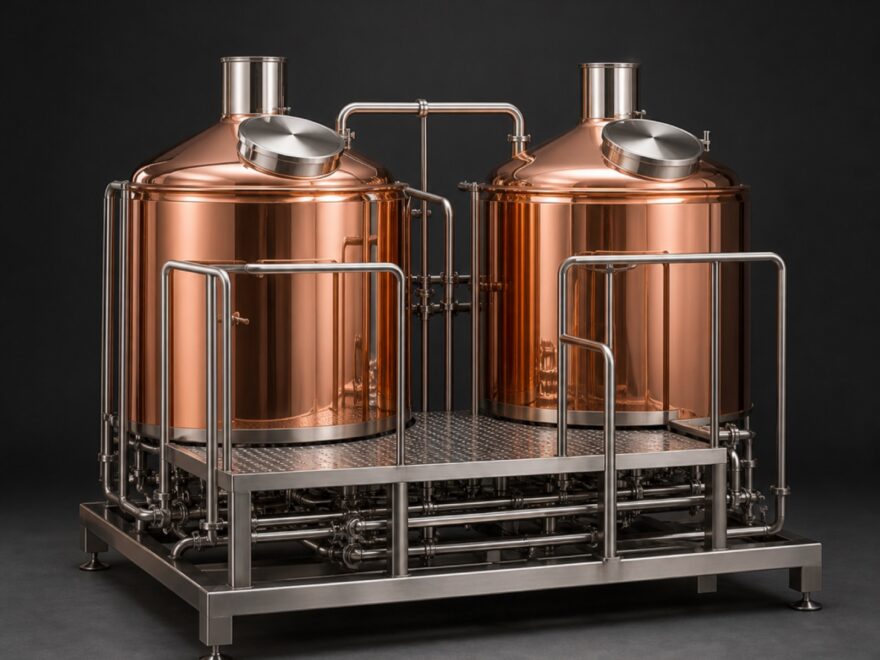
CV-300 Compact Two-Vessel Brewhouse
A three hectolitre mash-lauter and kettle-whirlpool pair on one frame, sized for taprooms, pilot cellars and recipe development without giving up production-grade…
- Batch size 3hL
- Vessel count 2

CV-1000 Three-Vessel Brewhouse
Ten hectolitres across a dedicated mash tun, lauter tun and kettle-whirlpool — the size most independent breweries settle on once the taproom…
- Batch size 10hL
- Vessel count 3

CV-2000 Four-Vessel Brewhouse
Twenty hectolitres with the whirlpool split out into its own vessel, releasing the kettle for the next boil and lifting the plant…
- Batch size 20hL
- Vessel count 4

CV-5000 Production Brewhouse
Fifty hectolitres per brew and five brews in a shift, with automated grist handling, spent grain removal and full batch records for…
- Batch size 50hL
- Vessel count 4

UT-10 Cylindroconical Unitank
A ten hectolitre working volume tank matched to a single CV-1000 brew, with two independent cooling zones so different parts of the…
- Total volume 12hL
- Working volume 10hL

UT-30 Cylindroconical Unitank
Thirty hectolitres working volume — three CV-1000 brews or one and a half CV-2000 brews — with the same two-zone cooling and…
- Total volume 36hL
- Working volume 30hL
Working out your own numbers
If you can tell us roughly how much beer you plan to make in a year, we can tell you what plant that needs. Send us your target volume and we will come back with a sized proposal — that is usually enough to start a conversation.