- Home
- Systems
- Fermentation Tanks
- UT-10 Cylindroconical Unitank

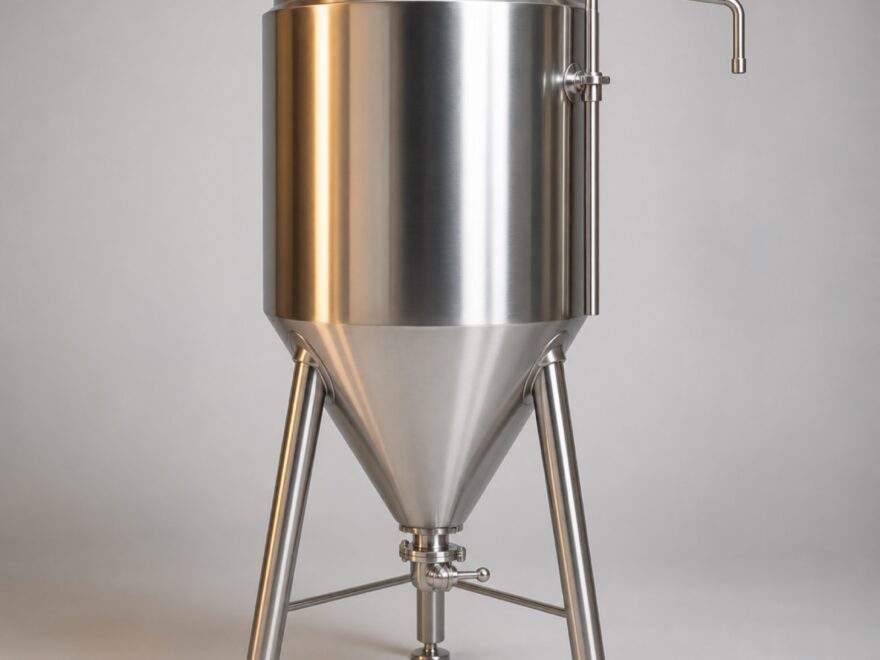
UT-10 Cylindroconical Unitank
Model UT-10
A ten hectolitre working volume tank matched to a single CV-1000 brew, with two independent cooling zones so different parts of the tank can be held at different temperatures.
- Total volume
- 12hL
- Working volume
- 10hL
- Design pressure
- 3bar
- Cone angle
- 60°
Description
The UT-10 is sized so one CV-1000 brew fills it exactly, with twenty-five per cent headspace left for the foam that active fermentation produces. That relationship — one brew, one tank — is what keeps a small cellar simple.
Two zones, not one
A single jacket forces a compromise: cool the cone and you stall the fermentation, cool the belly and the yeast never compacts. Two zones with separate valves and separate sensors let you hold the beer warm while it finishes maturing, then chill it from the bottom up.
Pressure that means something
Three bar is a real design pressure with a certified relief valve, not a marketing figure. It lets the beer carbonate naturally under its own pressure, and be moved between tanks without ever touching air — which is what keeps it tasting fresh.
Engineering highlights
- Two independent cooling zones let you chill the bottom of the tank while the main body stays at fermentation temperature.
- Rated for genuine pressure fermentation, so the tank can carbonate the beer naturally as it ferments.
- The internal cleaning spray is tested on every tank before it leaves the workshop, so it reaches every surface it should.
- The steep cone bottom lets yeast settle and drain out cleanly, with no manual scraping.
Specification
Technical data
| Model | UT-10 |
|---|---|
| Total volume | 12 hL |
| Working volume | 10 hL |
| Shell diameter | 1300 mm |
| Overall height | 3050 mm |
| Cone angle | 60° |
| Design pressure | 3 bar |
| Connected load | 0.4 kW |
| Material | 304 shell, 316L product contact |
| Lead time | 8 – 10 weeks |
| Headspace | 25 % at working volume |
| Cooling zones | 2 — cone and belly |
| Jacket | Laser-welded dimple plate |
| Insulation | 80 mm polyurethane foam |
| Internal finish | Polished sanitary finish |
| Carbonation | Built-in carbonation stone |
Dimensions are nominal and exclude platforms and insulation. Voltage, frequency and connection standards are built to the destination market.
Process flow, stage by stage
Select any stage to read what happens inside it, the process parameters we hold it to, and exactly which systems in the catalogue cover that part of the line.
Grist milling and dry handling
A two-roller mill cracks the husk without shredding it, then a dust-tight auger drops the grist straight into the hydrator. Gap is set from the panel so the same recipe delivers the same crush every single brew day.
Step mashing under recipe control
Steam or electric elements drive the mash through each enzymatic rest. The controller holds every step within a tight band and logs the whole curve, so a recipe written once repeats on any vessel in the range.
Wort separation and sparging
A fine stainless screen and slow-moving rakes draw clear wort from the grain bed without compacting it. The system watches the flow continuously and adjusts itself before the bed can stick.
Wort boiling and evaporation
An internal steam heater gives a rolling but gentle boil at a controlled rate, driving off unwanted flavours while protecting the colour of the beer. Steam vapour goes to a condenser so the brewhouse stays dry and the heat is recovered.
Settling and clarifying
The wort enters at an angle that sets up a smooth rotation, and the solids gather into a tight cone at the centre of the floor. A short rest leaves bright, clear wort ready for cooling, with very little lost.
Heat exchange and aeration
A two-stage heat exchanger takes the wort from the kettle down to fermentation temperature in a single pass, recovering the heat into the hot water tank along the way. Sterile air is added inline, ready for the yeast.
Fermentation and conditioning
Conical fermentation tanks carry the beer all the way from yeast to packaging without a transfer. Two independent cooling zones let different parts of the tank sit at different temperatures, and every tank holds its own setting.
Counter-pressure filling and seaming
A rotary counter-pressure filler purges each can, fills it under pressure and seams it under a carbon dioxide blanket. Low dissolved oxygen pickup is what keeps the beer tasting the same on week six as on day one.
Systems covering this stage
Also in the range
Systems that pair with this one

UT-30 Cylindroconical Unitank
Thirty hectolitres working volume — three CV-1000 brews or one and a half CV-2000 brews — with the same two-zone cooling and…
- Total volume 36hL
- Working volume 30hL
UT-60 Cylindroconical Unitank
Sixty hectolitres working volume for production cellars, with a reinforced cone, three cooling zones on request and a carbonation stone rated for…
- Total volume 72hL
- Working volume 60hL
Enquiry
Ask about the UT-10 Cylindroconical Unitank
Tell us the beer you plan to brew on it and where it will stand. We will confirm sizing, utilities and delivery, and send a firm quotation.
- Sized general arrangement drawing for your floor plan
- Steam, glycol, power and water loads confirmed in writing
- Delivery window and commissioning plan with the price
Request a quotation
A process engineer replies to every enquiry, usually within one working day.