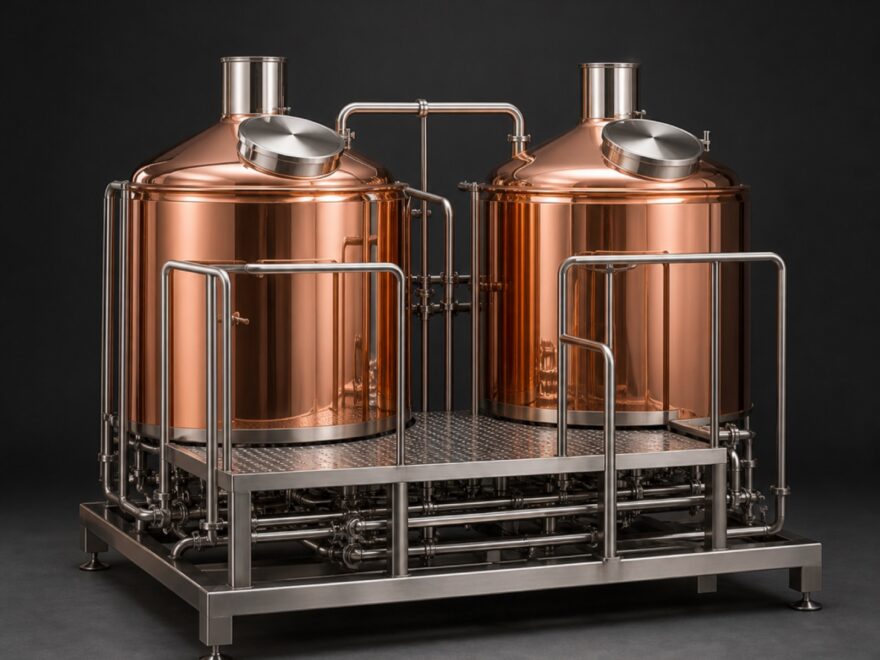
CV-300 Compact Two-Vessel Brewhouse
A three hectolitre mash-lauter and kettle-whirlpool pair on one frame, sized for taprooms, pilot cellars and recipe development without giving up production-grade…
- Batch size 3hL
- Vessel count 2

Craft Brewing Equipment Manufacturer
Coppervat designs, fabricates and commissions complete craft brewing plants — from a three-hectolitre pilot brewhouse to a fifty-hectolitre production line, with the fermentation, cooling, cleaning and packaging equipment engineered around it.
Capabilities
A brewery is a process, not a shopping list. We size the plant against your production plan, model the utilities, then build to that model in our own fabrication hall.
We start from your target annual volume and house style, then work backwards to brew length, vessel count and cellar capacity before anything is quoted.
Shells are rolled, welded and passivated in our own hall. Every product-contact weld is orbital, purged and logged against the vessel serial number.
One controller runs the brewhouse, the cellar and the cleaning cycles, with recipes that move unchanged between a pilot vessel and a production line.
Our engineers install, water-test and brew the first three batches with your team, then stay reachable for the life of the plant.
The Range
Every vessel, skid and cabinet in the catalogue speaks the same control protocol and uses the same tri-clamp standard, so a plant assembled from four categories still behaves like one machine.
A three hectolitre mash-lauter and kettle-whirlpool pair on one frame, sized for taprooms, pilot cellars and recipe development without giving up production-grade…
Ten hectolitres across a dedicated mash tun, lauter tun and kettle-whirlpool — the size most independent breweries settle on once the taproom…
Twenty hectolitres with the whirlpool split out into its own vessel, releasing the kettle for the next boil and lifting the plant…
Fifty hectolitres per brew and five brews in a shift, with automated grist handling, spent grain removal and full batch records for…
A ten hectolitre working volume tank matched to a single CV-1000 brew, with two independent cooling zones so different parts of the…
Thirty hectolitres working volume — three CV-1000 brews or one and a half CV-2000 brews — with the same two-zone cooling and…
The process
From milled grain to a sealed can, every stage of the line is something we design, build and commission ourselves. Select a stage to see what it does and which systems cover it.
Select any stage to read what happens inside it, the process parameters we hold it to, and exactly which systems in the catalogue cover that part of the line.
A two-roller mill cracks the husk without shredding it, then a dust-tight auger drops the grist straight into the hydrator. Gap is set from the panel so the same recipe delivers the same crush every single brew day.
Steam or electric elements drive the mash through each enzymatic rest. The controller holds every step within a tight band and logs the whole curve, so a recipe written once repeats on any vessel in the range.
A fine stainless screen and slow-moving rakes draw clear wort from the grain bed without compacting it. The system watches the flow continuously and adjusts itself before the bed can stick.
An internal steam heater gives a rolling but gentle boil at a controlled rate, driving off unwanted flavours while protecting the colour of the beer. Steam vapour goes to a condenser so the brewhouse stays dry and the heat is recovered.
The wort enters at an angle that sets up a smooth rotation, and the solids gather into a tight cone at the centre of the floor. A short rest leaves bright, clear wort ready for cooling, with very little lost.
A two-stage heat exchanger takes the wort from the kettle down to fermentation temperature in a single pass, recovering the heat into the hot water tank along the way. Sterile air is added inline, ready for the yeast.
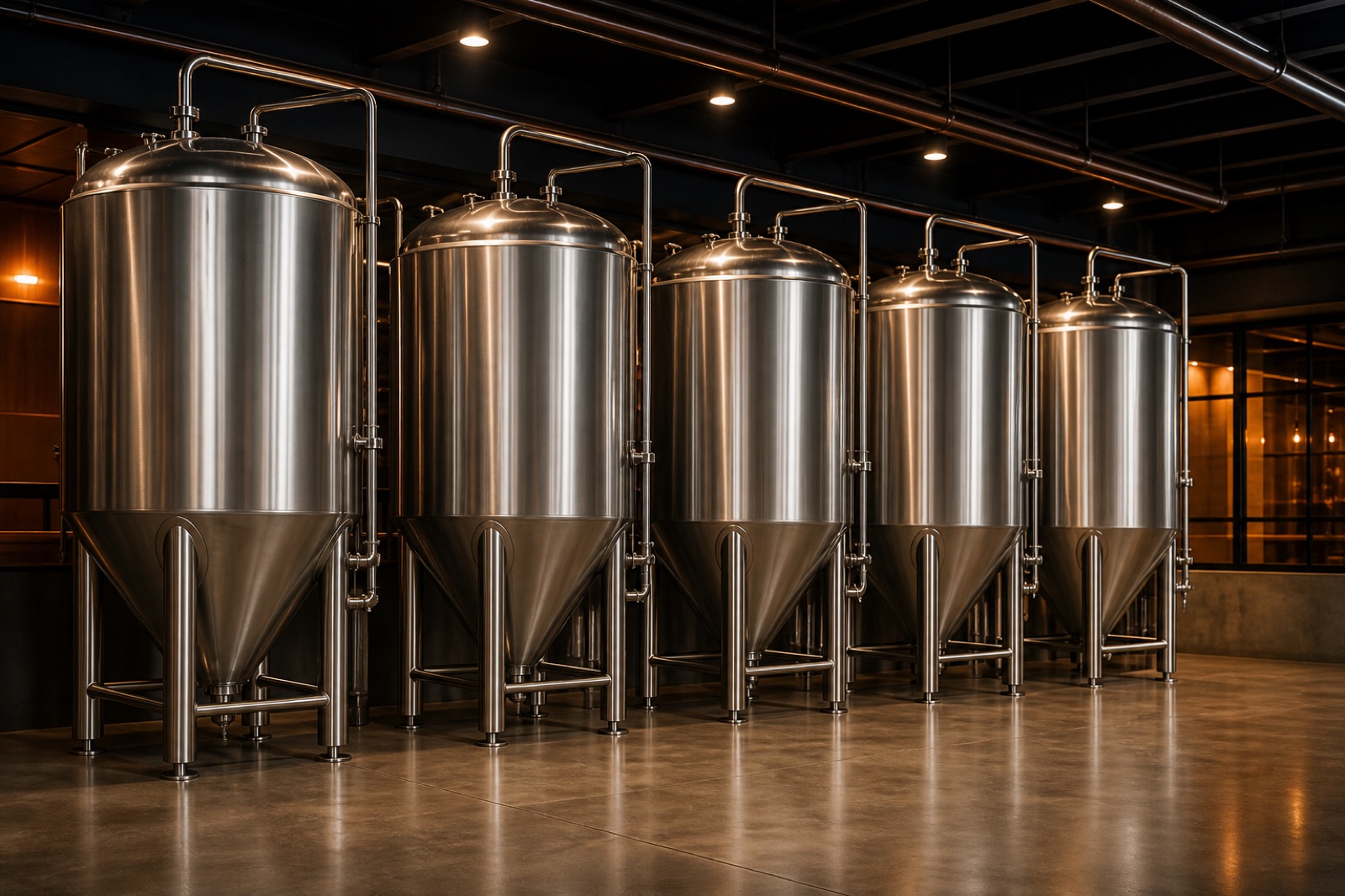
Conical fermentation tanks carry the beer all the way from yeast to packaging without a transfer. Two independent cooling zones let different parts of the tank sit at different temperatures, and every tank holds its own setting.
A rotary counter-pressure filler purges each can, fills it under pressure and seams it under a carbon dioxide blanket. Low dissolved oxygen pickup is what keeps the beer tasting the same on week six as on day one.

Fabrication
Beer finds every crevice. That is why every seam that touches the beer is precision welded, ground back and polished to a smooth finish you can wipe clean rather than scrub.
After handover
Buying the equipment is the start of the relationship, not the end of it. Every system we sell is backed by the same team that designed and built it.
Delivery
We agree the production plan, brew length and cellar turns, then issue a sized process and instrumentation diagram with a utility schedule.
General arrangement drawings are laid over your floor plan, checked for access, drainage and headroom, and signed off before fabrication opens.
Vessels are built, jacketed and pressure tested, and the control panel is wired and dry-run against the recipe library on the bench.
Our team sets the plant, runs the water test and cleaning cycles, then brews alongside your head brewer until the numbers repeat.
We asked for a brewhouse that three different brewers could run on three different shifts and still hit the same gravity. Two years in, the spread across four hundred brews is under a point.
Engineering notes
Every beer has a temperature it likes to ferment at. Holding it reliably is the job of the cooling system — and good design…
Some beers are brewed at one steady temperature, others move through several. Here is what that asks of your equipment, in plain language.
Most breweries pick a brewhouse by looking at what they can afford. Here is a simpler way to think about it: start from the…
Next step
Send us a target annual volume, a floor plan and a house style, and our process engineers will return a sized layout, a utility schedule and a firm quotation.
Tell us the beer volume you are planning for and where the plant will live. A process engineer will reply with sizing and a budget figure.
Tell us the volume you are planning for and where the plant will stand. A process engineer will reply with sizing, utilities and a firm price.


