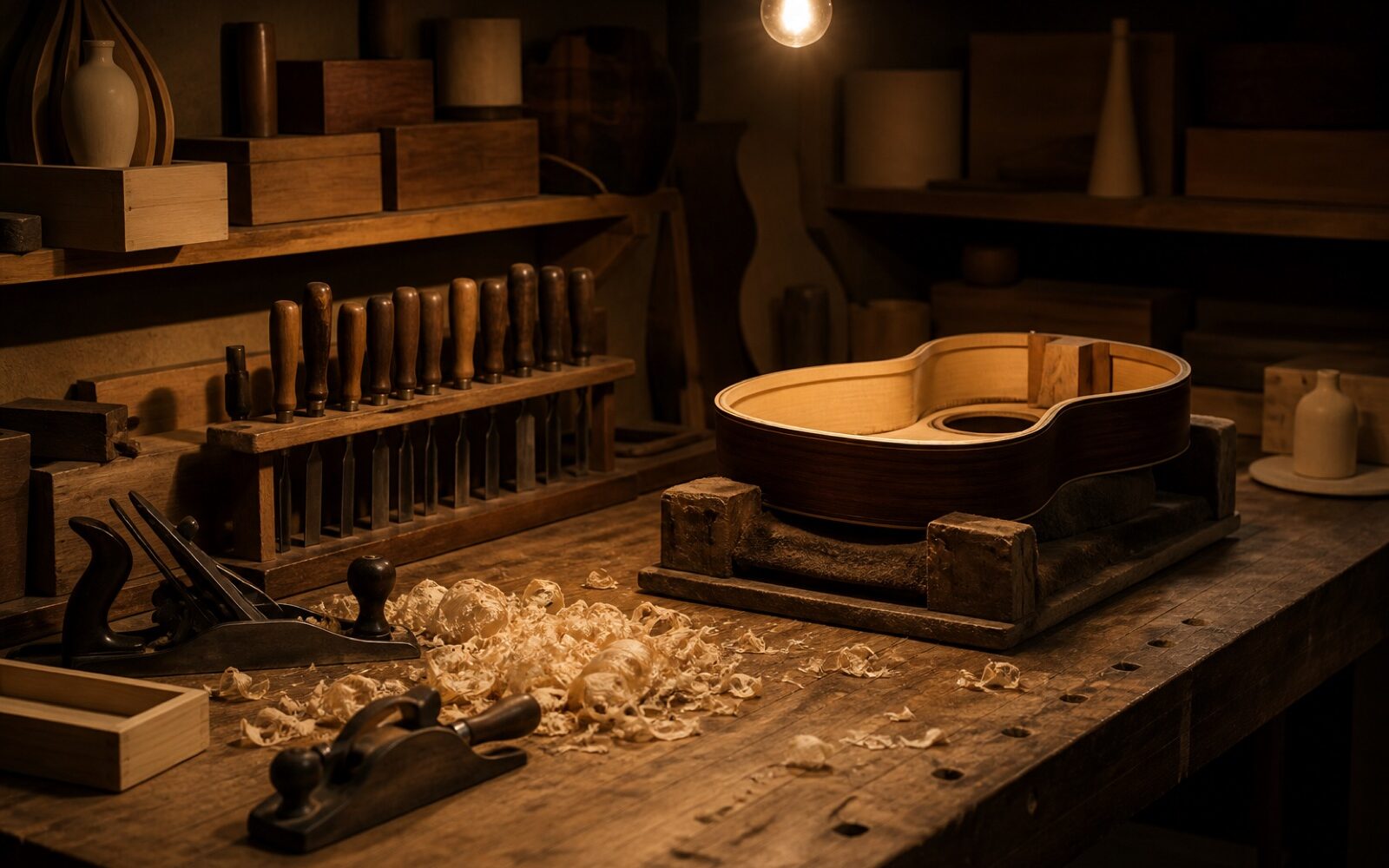
A small team, a loft full of slowly drying wood, and a fixed output of forty-two instruments a year. Here is how each guitar comes together, step by step.
Storing the wood
Wood arrives at the workshop and goes straight upstairs to the loft. Nothing is used until it has rested there for at least four years and has fully settled. We keep a record of every set as it arrives, and check it again before it comes down. Wood that has not finished drying will keep moving after the guitar is built, and no amount of careful work later can fix that.
At any moment there are hundreds of sets resting upstairs. A fair share are eventually set aside because they do not meet the standard we want for the instrument they were intended for.
Preparing the top
The top of the guitar — the soundboard — does most of the work of producing sound, so it gets the most attention. The two halves are carefully joined, glued and left to rest. Rather than working to a fixed measurement, we thin each top until it feels and sounds right for the instrument it will become. No two tops end up exactly the same, and that is by design.
Bracing
Inside every guitar top is a framework of thin wooden braces that give it strength and shape its sound. Each brace is fitted and glued by hand, then carefully shaved down while we listen — tap, remove a little wood, tap again — until the top rings clearly and evenly.
Different body sizes get different bracing layouts. Larger guitars need a stronger framework to handle powerful playing; smaller guitars use a lighter one so they stay lively and responsive.
Necks
Necks are carved by hand from a single piece of mahogany and fitted to the body with a traditional joint — carefully adjusted until it sits perfectly, with no shortcuts. For custom orders, the neck shape is carved to suit the player’s own hand.
Finish
Each guitar receives many thin coats of a traditional lacquer finish, then hangs in the finishing room for several weeks while it slowly hardens. Only then is it polished back by hand. A thin finish protects the wood while letting it vibrate freely, and it can always be repaired later in life.
Setup
Every instrument is strung up, played, adjusted and set up again before it ships. Our checklist covers the string height, the neck, the frets, the tuners and the tuning accuracy all the way up the fingerboard. The completed checklist goes in the case with the guitar.