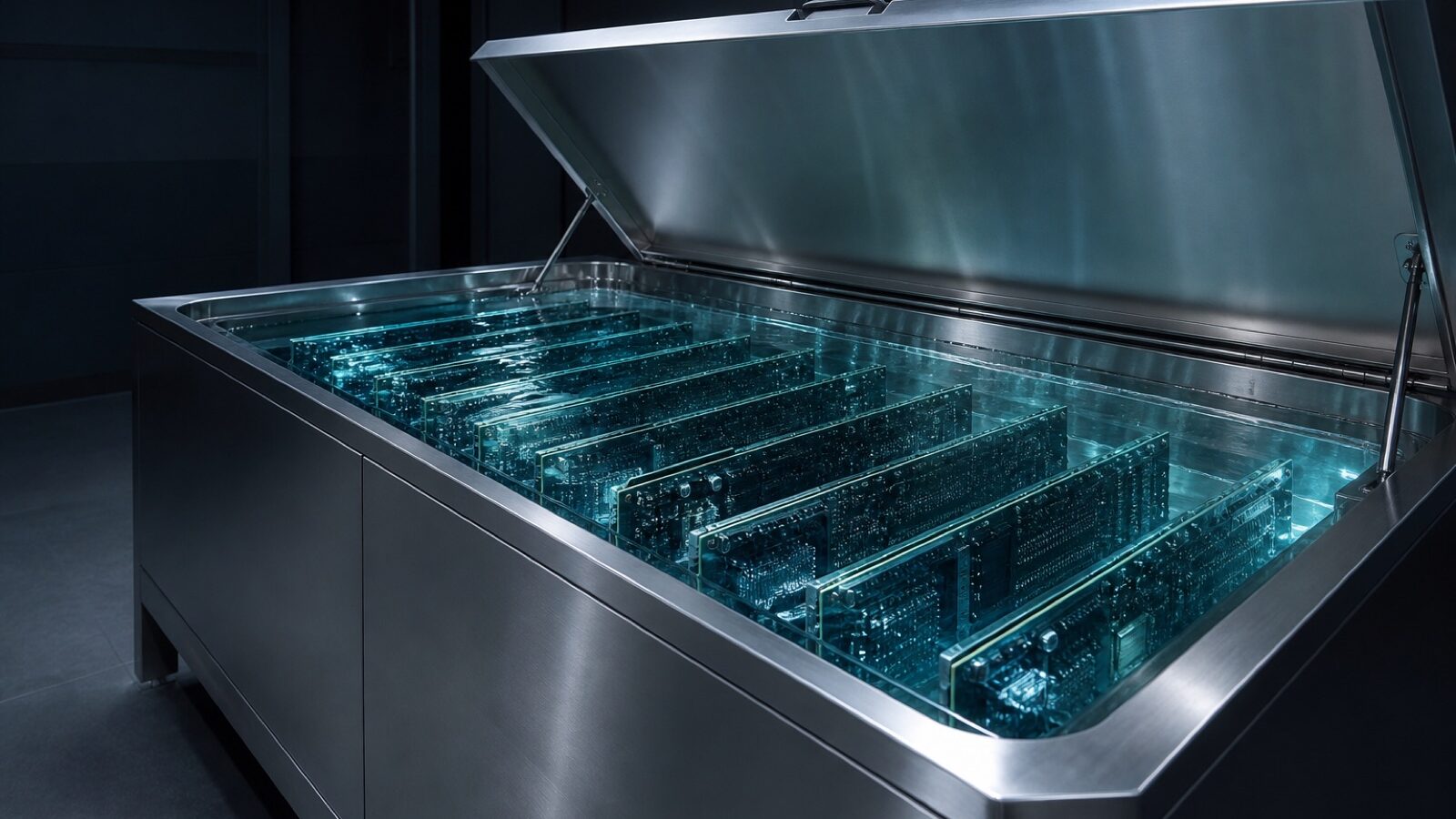
The direct-to-chip versus immersion argument generates more heat than either technology removes. The useful version of the question is narrow and answerable: what proportion of rack heat does each capture to liquid, and what does the remainder oblige you to keep running?
Heat capture ratio
Direct-to-chip captures 75 to 95 % of rack heat depending on how much of the board is plumbed. CPUs and GPUs always; VRMs and memory sometimes; drives and network almost never. Immersion captures 100 %, because there is nothing in the tank that is not in the fluid.
That gap looks small until you consider what it obliges you to do. At 85 % capture, a 130 kW rack still puts 19 kW into the air. Across a row that is enough to require a functioning CRAH plant with its own redundancy, maintenance and power draw. The last 15 % is what keeps your air system alive.
Which is why the PUE figures differ the way they do
Well-executed direct-to-chip lands around a 1.08 partial PUE. Immersion reaches 1.04. The difference is almost entirely the residual air handling that direct-to-chip cannot eliminate, plus the server fans that immersion deletes outright.
Where direct-to-chip clearly wins
Serviceability and familiarity. A cold-plated server is still a server: it slides out on rails, a technician works on it dry, and any component can be replaced with standard procedure. Hardware qualification is straightforward and vendors increasingly ship plates factory-fitted.
For a colocation operator whose tenants swap hardware unpredictably, this is decisive. Immersion requires control over what goes in the tank, and colocation is defined by not having that.
Where immersion clearly wins
Density above 120 kW per rack, total heat capture, no fans anywhere, and the highest efficiency available. If you own the hardware, control the refresh cycle and are building for density, immersion is the stronger engineering answer and it is not close.
The operational cost nobody quotes
Immersion changes how your team works. Boards come out wet and go on a drip tray. Labels and some plastics need fluid-compatibility qualification. Fluid is a managed consumable with a sampling schedule. None of this is difficult, but all of it is different, and it has to be decided deliberately rather than discovered at commissioning.
How we actually advise
Below 120 kW per rack, direct-to-chip, because the operational continuity is worth more than four points of partial PUE. Above 120 kW, immersion, because nothing else gets there. If you do not control your own hardware, direct-to-chip regardless of density. And if you are between 45 and 90 kW, consider that an active rear door may serve you better than either — it needs no change to the server at all.