Most sites choose a facility water temperature by inheriting one. The loop was built for chilled water at 7 °C, so that is what the CDU gets, and a chiller runs all year to maintain a condition nothing in the room actually needs.
What the ASHRAE classes mean in practice
The W-classes describe the supply temperature the IT equipment can tolerate. W17 means 17 °C supply; W45 means 45 °C. Modern cold plates are qualified across most of that range. The question is not what the servers can take — it is what the climate can give you for free.
Where free cooling starts
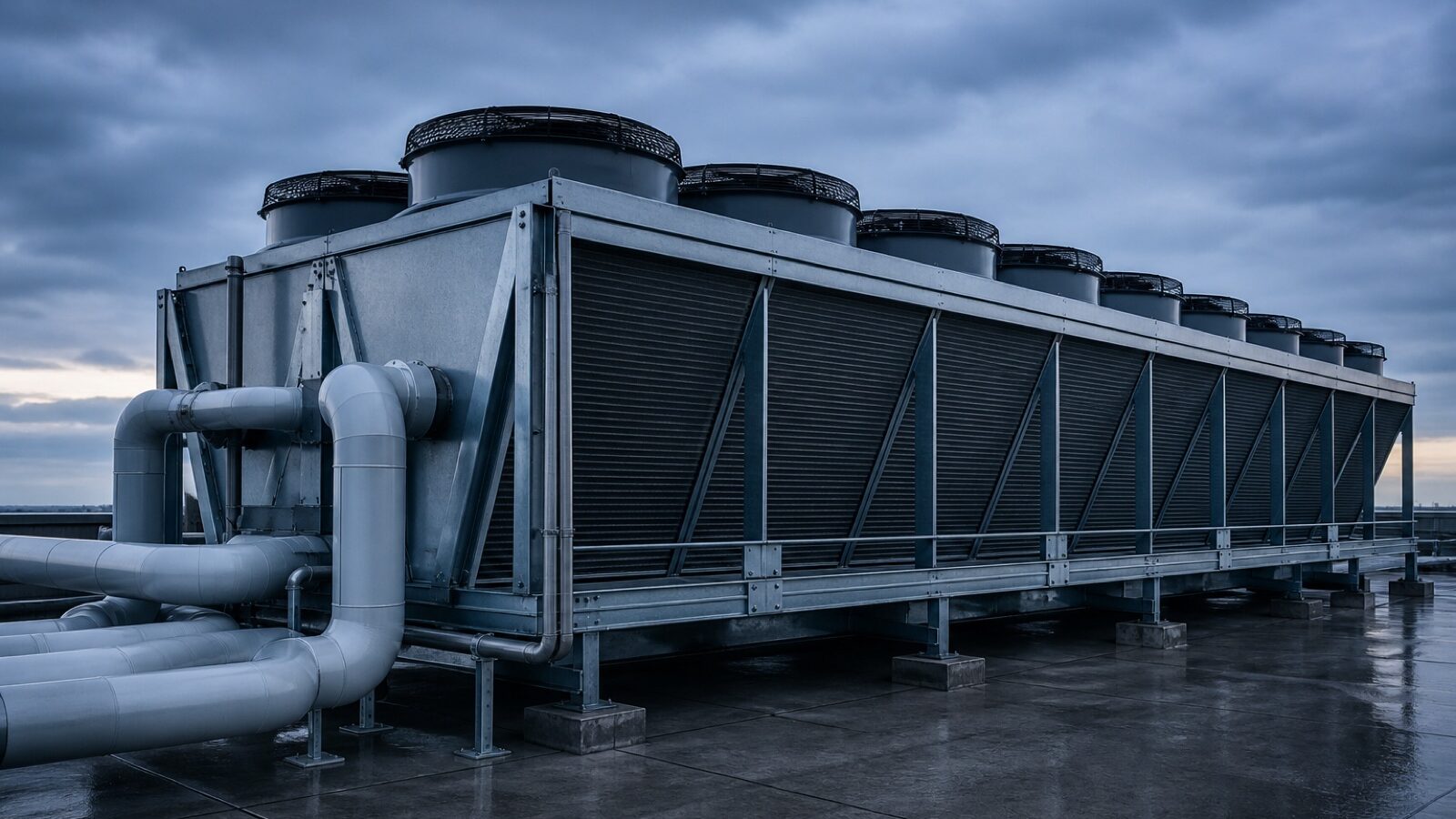
A dry cooler rejects heat whenever the water is warmer than the air. At 7 °C supply that is almost never, so a chiller runs continuously. At 30 °C supply with a 10 K rise, you are rejecting 40 °C water to ambient — a condition met for roughly 8,100 hours a year in a temperate climate.
That is the whole argument. Not a better chiller: no chiller, for all but a few weeks of summer afternoons.
The counter-argument, honestly stated
Warmer water is not free of consequences. Component temperatures rise, so the margin between operating and throttling narrows. Leakage current increases slightly with junction temperature, which shows up as a small rise in server power. Some drive and memory specifications tighten above certain inlet conditions.
In our experience these effects are real but small compared with eliminating chiller operation. They are worth modelling rather than assuming in either direction.
Delta-T is the other half
Supply temperature sets whether you can free cool. Delta-T sets how much water you have to move to do it. Going from a 6 K to a 12 K rise halves the flow rate, and because pump power scales with roughly the cube of flow, it cuts pumping to about an eighth.
Wide Delta-T is nearly always the right choice, bounded by the return temperature your rejection plant can use and by the temperature stability the servers need.
Heat reuse changes the arithmetic again
A 45 °C return is a district-heating asset. At that grade the heat has somewhere to go besides the sky, and several of our European customers have turned a rejection cost into a revenue line. A 32 °C air plume has no such option, which is a point worth making to anyone still choosing between the two.
A reasonable default
For a new build with no legacy constraint we usually recommend designing around W30 to W32 supply with a 10 K rise. It free cools for most of the year almost anywhere, keeps comfortable component margin, and leaves the door open to heat reuse without committing to it.