The argument for liquid cooling is usually made with efficiency figures. That is the wrong place to start, because efficiency is a preference and physics is not. Air cooling does not become expensive above 25 kW per rack. It becomes impossible.
The number that decides everything
Water carries about 3,000 times more heat per unit volume than air at the same temperature difference. That single ratio governs every decision downstream of it. To remove 130 kW from a rack with a 12 K air temperature rise you need roughly 36,000 cubic metres of air per hour moving through a cabinet with a face area under two square metres.
That is an air velocity no chassis will produce and no containment will survive. Long before you reach it, the fans have become a significant fraction of the load they are trying to remove.
The fan power tax
Server fan power scales with roughly the cube of speed. Doubling airflow costs eight times the fan power. In a dense air-cooled rack the fans alone consume 8 to 15 % of IT power — power you buy, and whose heat you then also have to remove.
This is the part that surprises people: at high density a meaningful share of your cooling load is the cooling system itself. Liquid cooling gives most of it back, and it gives it back twice, because the power is not spent and the heat is not made.
Where each technology actually stops
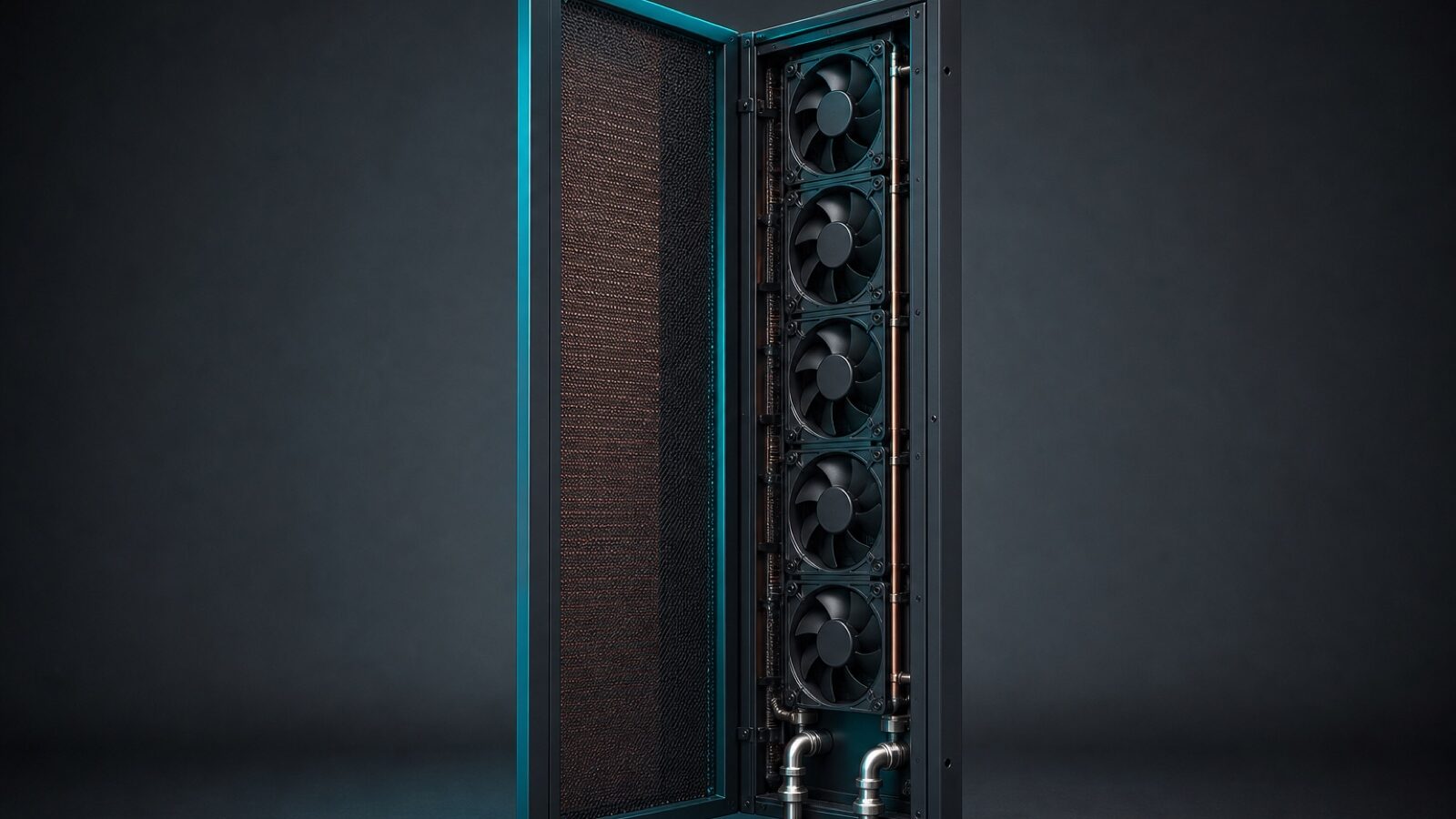
A raised floor with no containment manages perhaps 8 kW per rack. Contained aisles with in-row units reach about 25 kW. A passive rear door coil takes it to 45 kW because it removes the heat at the cabinet boundary instead of hauling it across the room. Fan-assisted doors reach 90 kW.
Past that the air path itself is the constraint, not the heat rejection. Cold plates take CPU and GPU heat out at the package and carry racks to 160 kW. Immersion removes the air path entirely and reaches 200 kW.
Throttling is the failure mode
Air cooling rarely fails visibly at high density. It fails as clock throttling — a few percent of sustained performance, invisible unless somebody is watching the frequency counters, on hardware that cost more than the cooling plant. The finance case for liquid cooling is often stronger from recovered compute than from saved electricity, and almost nobody models it that way.
What to do with this
Work out your real per-rack power at peak simultaneous load, not nameplate. If it is under 25 kW, air with containment is still the right answer and anyone telling you otherwise is selling something. If it is over 45 kW, the decision has already been made for you by the physics — what remains is choosing which liquid path fits your operations.