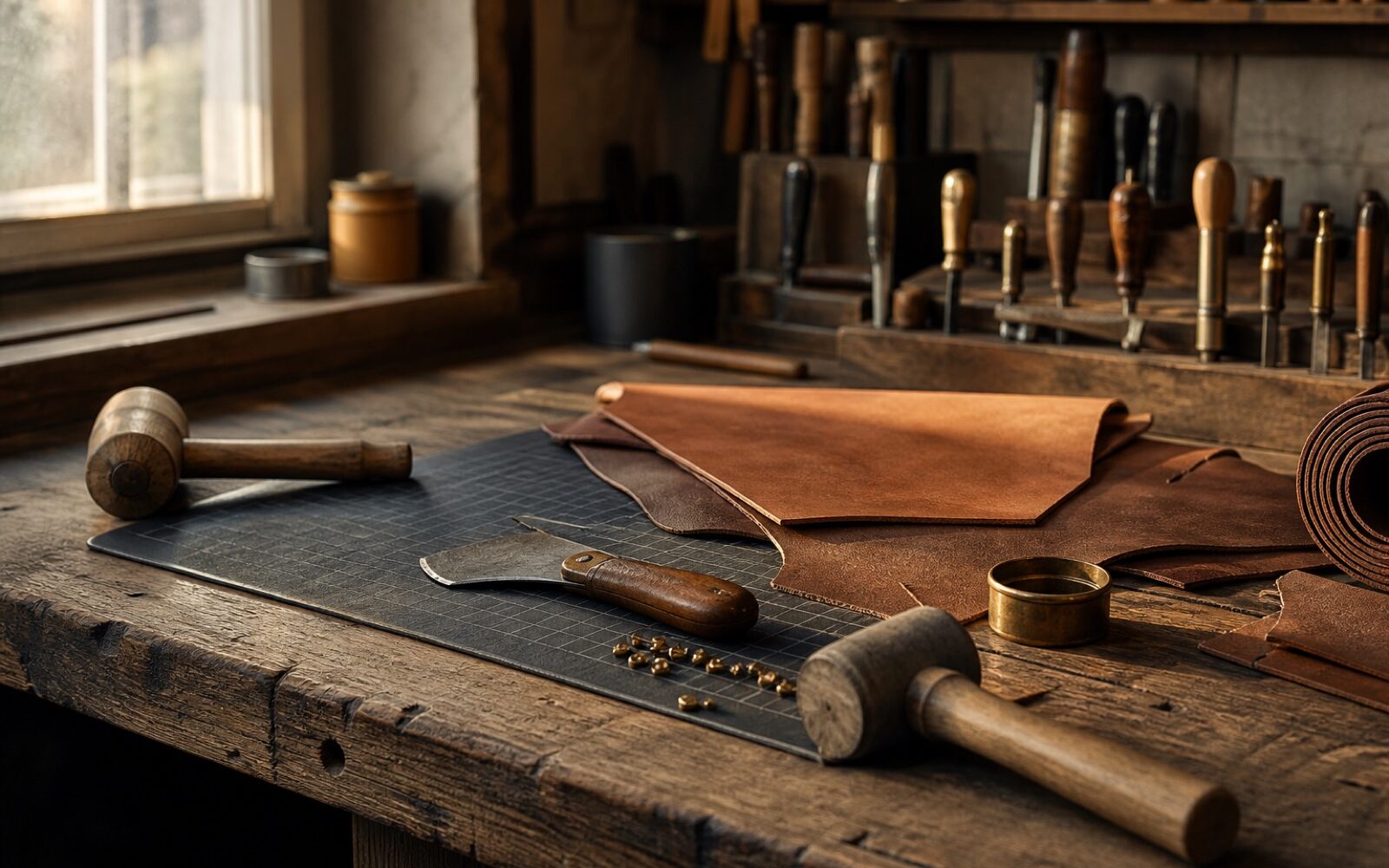
We are two people, one room and a great many hand tools. Everything sold here was cut, stitched, sanded and oiled within about four metres of where you are reading this sentence.
How it started
In 2009 we rented the back corner of a furniture shop for eighty dollars a month, mostly because it had a north-facing window and a bench nobody else wanted. The first year produced eleven belts, four bags and a great deal of ruined leather. Most of what we know now was learned by wasting hides.
The shop moved twice, then settled on Currier Lane in 2014. It has the same window orientation, the same bench, and — with two exceptions — the same tools.
What has not changed
The process is unglamorous and has not moved in sixteen years:
- Select. Hides are chosen by hand at the tannery. We reject roughly a third for range marks in the wrong places, thin bellies, or a grain that will not take a burnish.
- Cut. A round knife on a marble slab. Panels for a single bag come from a single hide so the grain runs true across the whole piece.
- Skive. Every fold is thinned by hand with a French edger. This is the slowest step and the one customers never see.
- Punch and stitch. Pricking irons mark the line, an awl opens each hole, and two needles pull a saddle stitch at nine stitches to the inch.
- Burnish. Edges are sanded through four grits, dyed, then slicked with beeswax until they shine.
- Oil and rest. A coat of neutral balm, then a day on the shelf before it is boxed.
Why hand stitching
A machine lock-stitch is one thread looping through itself. Cut it anywhere and the seam unzips. A saddle stitch is two threads passing each other in opposite directions through every hole — cut it and the two stitches either side hold. That is the whole argument, and it is why a repaired bag from 1970 still exists and a bonded one from 2019 does not.
Repairs
Send anything back at any age. We restitch seams, replace hardware, re-dye edges and rebuild straps at the cost of the materials, which is usually somewhere between fifteen and sixty dollars. We would rather fix a fifteen-year-old satchel than sell a new one.
Visiting
The bench is open to visitors Tuesday to Saturday. Email ahead — if we are wet-forming, the door tends to be shut. Bring whatever you own that needs looking at.