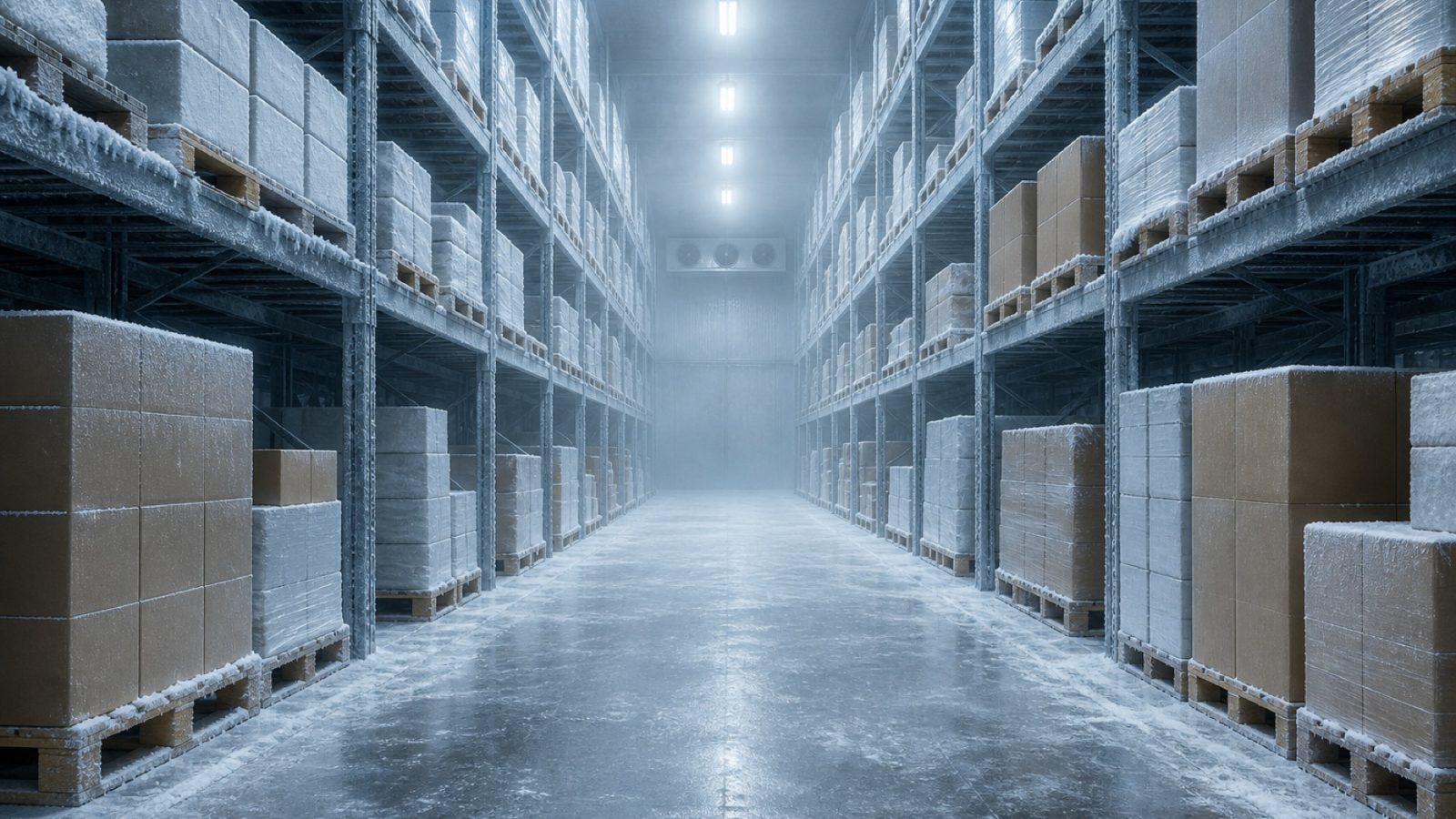
Refrigerated cube is the most expensive storage volume in most businesses, so cold stores are where density systems earn their keep. The usual shortlist is drive-in against radio shuttle. Both replace aisles with lanes. They are not interchangeable, and the choice is easier to make on four questions than on a cost comparison.
How deep are the lanes going to be?
Drive-in lanes are worked by a truck that reverses in and out. Beyond about six pallets deep, cycle times rise and driver confidence falls, and both show up as damage rather than as a number in a report. A radio shuttle has no such limit: the truck stays at the lane entry and the shuttle does the travel, so lanes can run to twenty positions or more without the cycle time getting worse per pallet.
If your lanes are four to six pallets deep, drive-in does the job and the shuttle is buying depth you have no room for. If the building is long enough for fifteen-pallet lanes, drive-in throws that away.
What happens to the racking?
In drive-in, a mast enters the structure several hundred times a day, in the dark, in a freezer, with a driver in a padded coat. The entry frames and rails take that. It is designed for, which is why entry frames are heavier and deflectors are a bolted replaceable part, but the maintenance is real and it never stops.
In a shuttle system nothing with a mast goes inside the lane. The damage profile changes from continuous internal impact to occasional damage at the lane entry. In a freezer, where the truck is generally the least reliable part of the operation, that is often the argument that decides it.
How good are the pallets?
This question sinks more shuttle projects than cost does. A truck drives over a broken bottom board without noticing. A shuttle runs on rails under the pallet and will stop against one, in the middle of a full lane, at minus twenty-five. Deep-lane automation needs pallet quality to be controlled: consistent dimensions, sound bottom boards, no overhang. If your inbound pallets come from fifty suppliers in unknown condition, either fix that first or specify drive-in.
Where do you want the cost to sit?
Drive-in puts the cost in the structure and the trucks. Radio shuttle puts less in the structure per pallet position, adds shuttles, and needs charging and a place to keep them. Because one shuttle serves many lanes, that cost scales with throughput rather than with pallet count. A store with many lanes and modest daily movement needs few shuttles; a fast store needs several.
The decision that is not about either
Both systems are lane-based, so both are last-in first-out unless you load one face and pick the other. If your stock is dated and you need genuine first-in first-out, that costs you a second aisle and it has to be decided before the frames are set out, not after. Neither system forgives that being an afterthought.
Finally, specify the finish for the room rather than for the catalogue. In a freezer we supply hot-dip galvanised frames, because corrosion at the door line starts at the cut edge of the perforation and inside the box section, and those are the surfaces a sprayed coating reaches last.