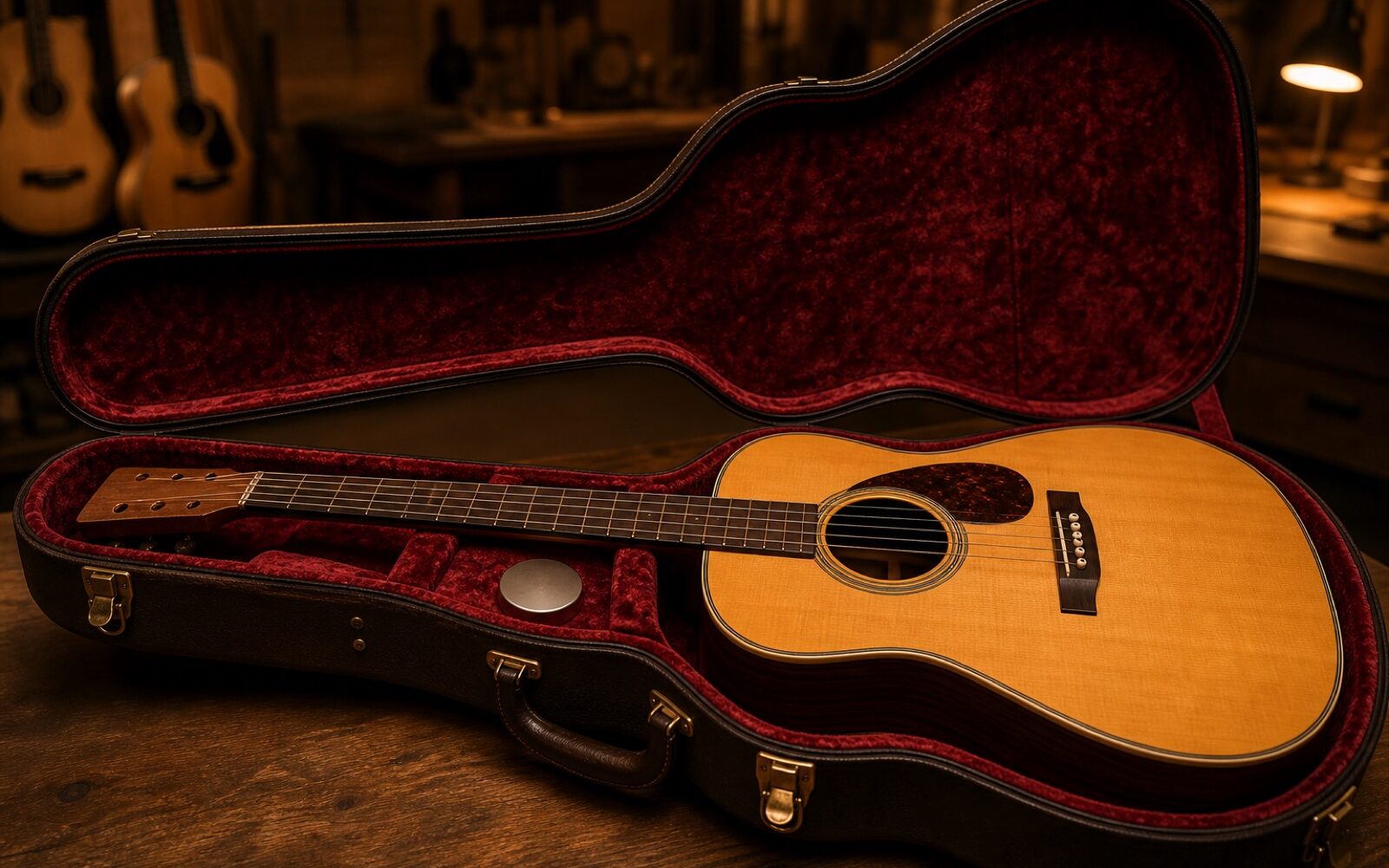
Over the years we have repaired far more instruments damaged by dry air than by being dropped. If you only ever do one thing for your guitar, put a hygrometer in the case.
What is physically happening
Wood moves across the grain and barely at all along it. A soundboard’s grain runs from neck to tail, so when it dries it shrinks side to side. The braces glued to its underside run across that direction and do not shrink. Something has to give, and it is the top.
Even a small drop in humidity makes a solid wood top measurably narrower — far more movement than the glue joints can absorb.
The numbers
| Relative humidity | What you will see |
|---|---|
| Below 30% | Sharp fret ends, sunken top, buzzing, then cracks |
| 30–40% | Action drops, tone thins, seams begin to creep |
| 45–55% | Where we build, and where you should keep it |
| 60–70% | Action rises, tone goes dull and slow |
| Above 70% | Bridge lifts, glue joints creep, finish clouds |
What to actually do
- Buy a hygrometer and put it inside the case, not on the wall. Room readings are useless because the case is a different microclimate.
- Use two-way regulating sachets. They both absorb and release, so they fix the summer problem as well as the winter one. Replace them when they go hard, roughly every four months.
- Keep the guitar in the case when you are not playing it. A wall hanger looks better and offers no protection at all.
- In a cold climate, remember that heating a room drops relative humidity dramatically. A house at 21 degrees in February can sit under 20 per cent.
If it has already happened
Do not try to close a crack by re-humidifying and hoping. Bring the instrument back to 45 per cent slowly over a week or two, then send it to us. A clean crack cleated from the inside while it is closed is an invisible repair; the same crack left open for a season and filled is not.