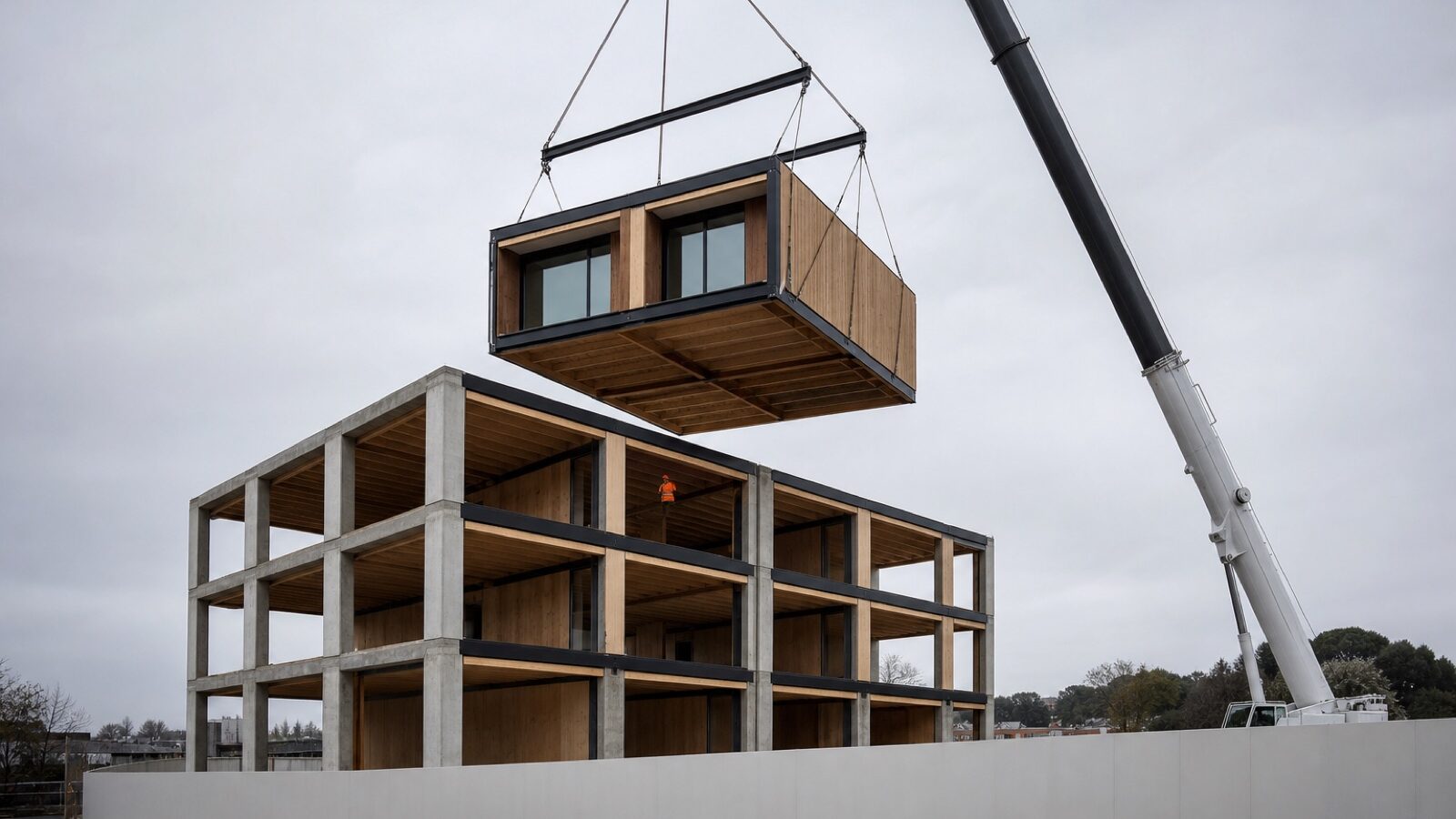
The most common misconception about volumetric construction is that we build faster. We do not. A bathroom takes about as long to fit out in our plant as it does on the fourteenth floor of a tower.
What changes is when it happens.
Serial versus parallel
On a traditional job the sequence is fixed by gravity and by trade dependency: you cannot render a wall that does not exist, and you cannot second-fix a room that is not weathertight. Every activity inherits the delay of the one before it, which is why a six-week overrun in the superstructure becomes a six-week overrun at handover.
On a modular job, foundations and manufacture happen simultaneously. The site is not waiting for the plant and the plant is not waiting for the site. They meet once, on the day the first unit is craned in, and from that moment there are only three activities left: set, stitch, commission.
Reading the bars honestly
When you see a modular programme, look for three things.
- Where does the factory bar start? If it starts at week zero, the programme is fiction — nothing can be manufactured before design freeze.
- How long is the gap between the end of foundations and the first lift? That gap is float, and float is where the risk lives.
- How long is stitching? This is the activity everyone underestimates. Inter-module connections, riser tie-ins, roof and façade completion are real work, and on a 100-unit scheme they are eight to twelve weeks.
The honest saving
Across our delivered projects the saving to practical completion sits between 45% and 58% depending on scale, and the saving in site presence — the number of weeks there are lorries, generators and people on a residential street — is consistently higher, around 65%.
For a school or a hospital, that second number is usually the one that wins the job.