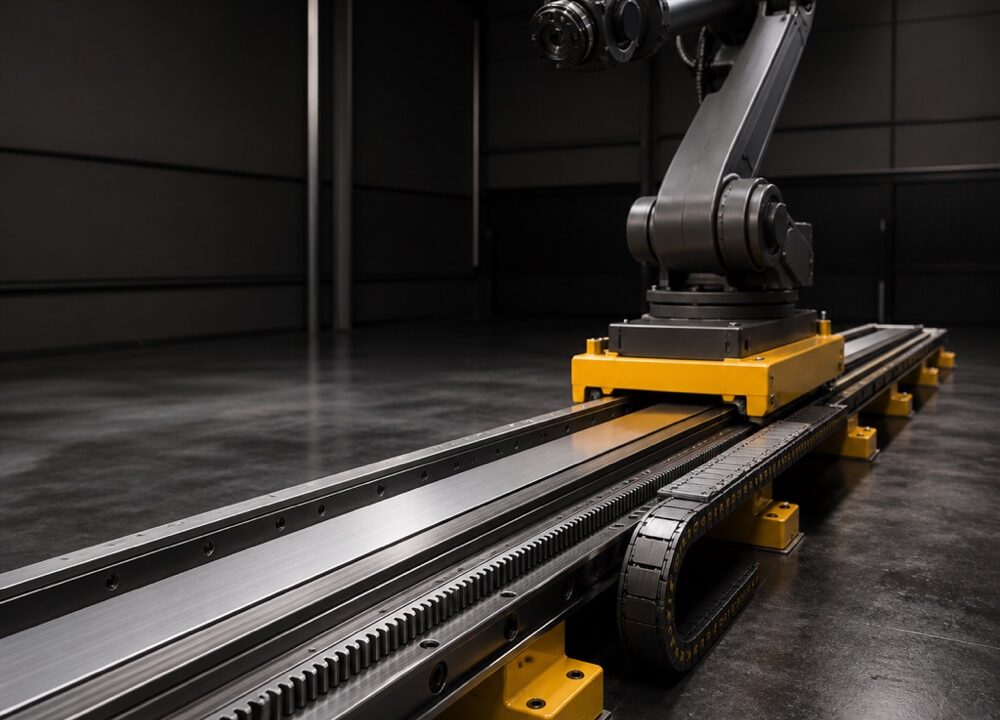
A robot on a rail is often the most economical way to raise utilisation. Instead of two cells with two robots, one robot serves several stations along the track: while it welds at one station, the operator loads the next.
Rigidity first
A rail is only useful if it does not add positional error. The track is precision-built, carefully levelled and aligned during installation, and its accuracy is verified before handover.
Built for the welding environment
Guides and drives are protected against spatter and dust, because in welding cells it is contamination — not wear — that usually shortens component life.
| Stroke | 2 000 – 12 000 mm |
|---|---|
| Carriage payload | 600 kg |
| Repeatability | ±0.05 mm |
| Maximum speed | 1.6 m/s |
| Acceleration | 2.0 m/s² |
| Drive | Servo motor, helical rack and pinion |
| Guideways | Hardened profile rail, four-block carriage |
| Protection | Bellows cover, IP54 carriage |
| Cable management | Steel energy chain, weld-spatter shielded |
| Levelling | Machined base with grout channels |


