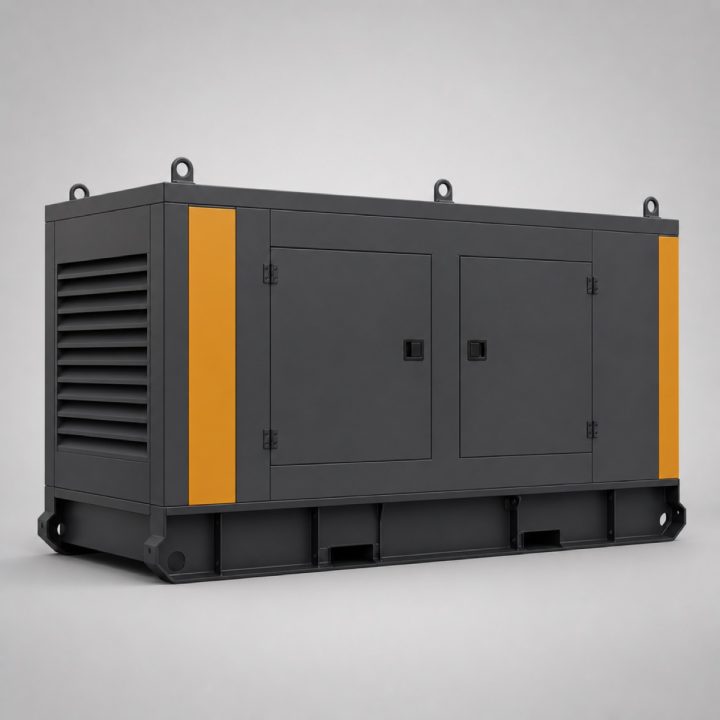
PC-D110
PC-D110 Open Frame Diesel Generating Set
- Standby rating (ESP) 110 kVA / 88 kW
- Prime rating (PRP) 100 kVA / 80 kW
Diesel and gas generating sets
Standby and prime sets from 20 to 2500 kVA. Open frame, soundproof canopy, containerised or gas, with the alternator matched to the engine and every set load-bank tested before it ships.
Selected sets
Send us the connected load, the starting profile of the largest motor and whether the set runs standby or prime. We confirm the rating and the engine that carries it.
All setsPC-D110
PC-D400
PC-S200
PC-S650
PC-C1250
PC-G500
How a set is built
We start from the load schedule, not the catalogue. Connected kW, the largest motor and how it starts, the harmonic content of any drives or UPS, and whether the set is there for standby, prime or continuous duty. That decides the rating class before it decides the model.
Engine and alternator are selected as a pair. Block-load acceptance, transient voltage dip and recovery time are checked against the sizing case, and the alternator is derated for site altitude and ambient temperature rather than quoted at sea level.
Baseframe, anti-vibration mounts, tank, exhaust, cooling package and control panel are assembled and wired to the drawing set for that order. Every set is given a serial number and its own build record before it moves to the test bay.
Resistive load bank, stepped to full rating. Voltage and frequency regulation, temperature rise, fuel burn and alarm and shutdown functions are logged, and the record is filed against the serial number so the numbers stay traceable years later.
Product range
Open frame, canopy, container, gas, trailer and transfer switchgear. The rating and control philosophy carry across all of them; the enclosure follows the site.
View all productsWhere they run
The same engine and alternator are packaged four different ways depending on what the installation has to do at the moment the mains drop.

Standby duty behind the UPS, with block-load acceptance checked against the step the static switch actually presents. Parallel sets, N+1 arrangements and a control system that starts, synchronises and sheds load without an operator on site.

Prime duty on an unmade surface. Skid or trailer mounting, a bunded tank sized for the working day, lifting eyes and forklift pockets, and a canopy that survives being craned onto a slab twice a month.

Life-safety circuits transfer on a defined time, so the set is specified around start-to-load rather than headline kVA. Load-bank testing at commissioning and a documented result for the facility file.

Large motor starts, variable-speed drives and a load that is neither linear nor polite. Alternator reactance and excitation are chosen for the starting case, not the running case.
What comes with the set
Load schedule, starting method and duty class reviewed before a rating is quoted, with site altitude and ambient temperature applied as deratings.
Stepped resistive load to full rating, with regulation, temperature rise and shutdown functions logged against the serial number.
Test record, wiring diagrams, control panel manual and the parts list for the engine and alternator actually fitted to that set.
Filters, belts, AVRs, sensors and control boards held for the models we have supplied, matched to the serial number rather than a model range.
Newsroom
The transfer switch is rated for the mains, not for the generator, and the interval nobody specifies is the one the load actually notices.
A monthly off-load exercise proves the battery is charged and the starter turns. It does not prove the set can carry the building.
A bigger set is not a safer set. Lightly loaded diesels wet-stack, and the rating label you choose decides what you are allowed to do with the machine.
Talk to a sizing engineer
Connected kW, the largest motor and how it starts, the duty class and the site altitude. You get back a rating, a candidate model and the fuel and sound figures for it.
Include the load schedule and the site conditions. The reply comes from the engineer who sizes the set.
Please share your requirements, quantity, and specifications. We will reply promptly.