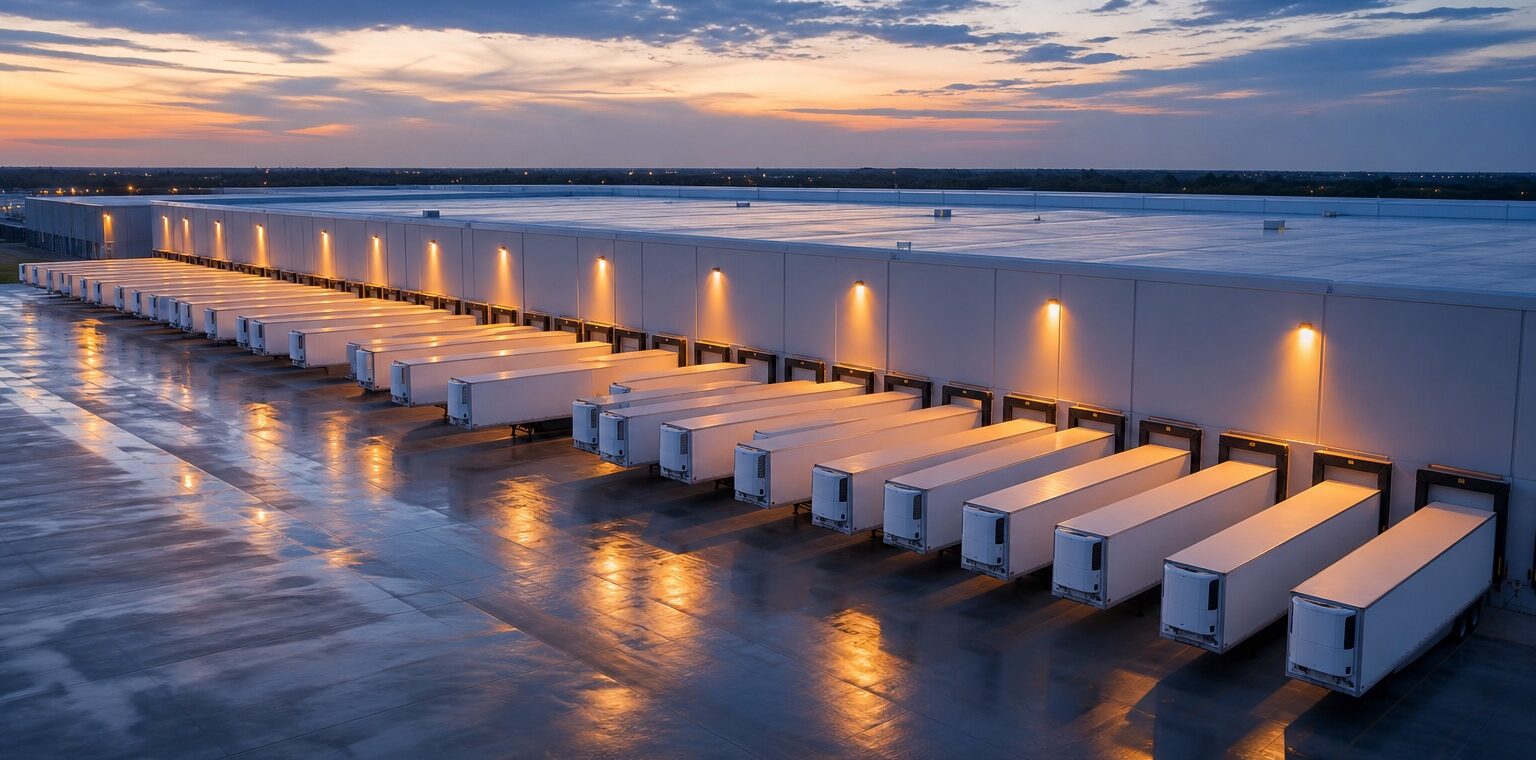
The network is built around eight owned nodes and the scheduled trunks between them. We do not sub-contract the trunk legs, because the moment a lane leaves our telemetry it stops being a lane we can stand behind.
Node types
Port cold ports
Quayside facilities with powered reefer plug fields, bonded chambers and customs-side inspection capacity. Vantrell Harbour is the primary sea gateway with 640 powered slots.
Automated high-bay freezers
Dark-store operation with no routine human entry, which removes the single largest heat load from a deep frozen hall. Kestrel Flats runs 34 metres of clear height across 38 900 positions.
Pharmaceutical campuses
GDP-licensed premises with segregated quarantine bays and an ultra-low bank. Ambervale carries the 2 – 8 °C, 15 – 25 °C and −80 °C chambers for the life sciences lanes.
Urban satellites
Small, night-loaded facilities whose only job is to condition and dispatch passive shippers onto morning routes. Halcyon Reach and Drift Point cover the metropolitan areas.
Lane times
| Lane | Scheduled transit | Frequency |
|---|---|---|
| Vantrell Harbour → Kestrel Flats | 5 h | Twice daily |
| Kestrel Flats → Ambervale | 7 h | Daily |
| Ambervale → Solmere Gate | 4 h | Daily |
| Solmere Gate → Tarrowick | 3 h | Twice daily |
| Norn Basin → Halcyon Reach | 4 h | Nightly |
All facility and place names on this site are fictional and used for demonstration purposes only.