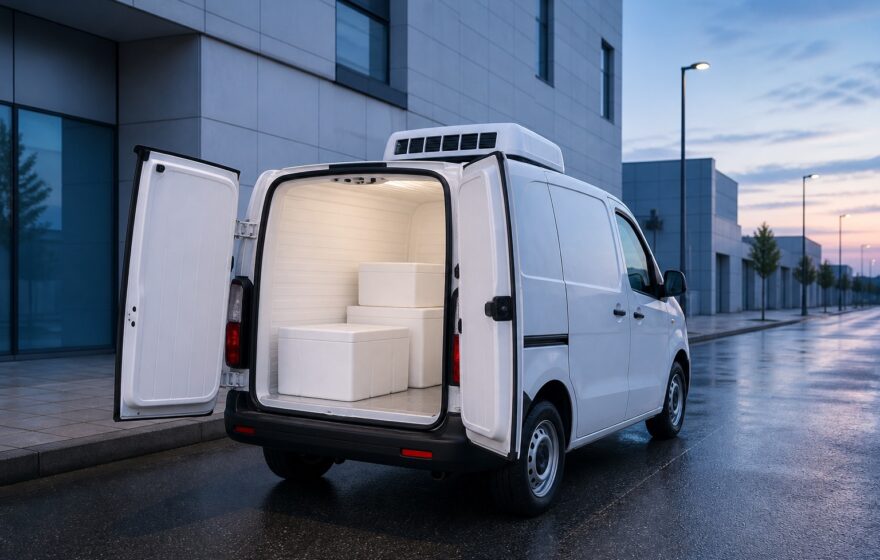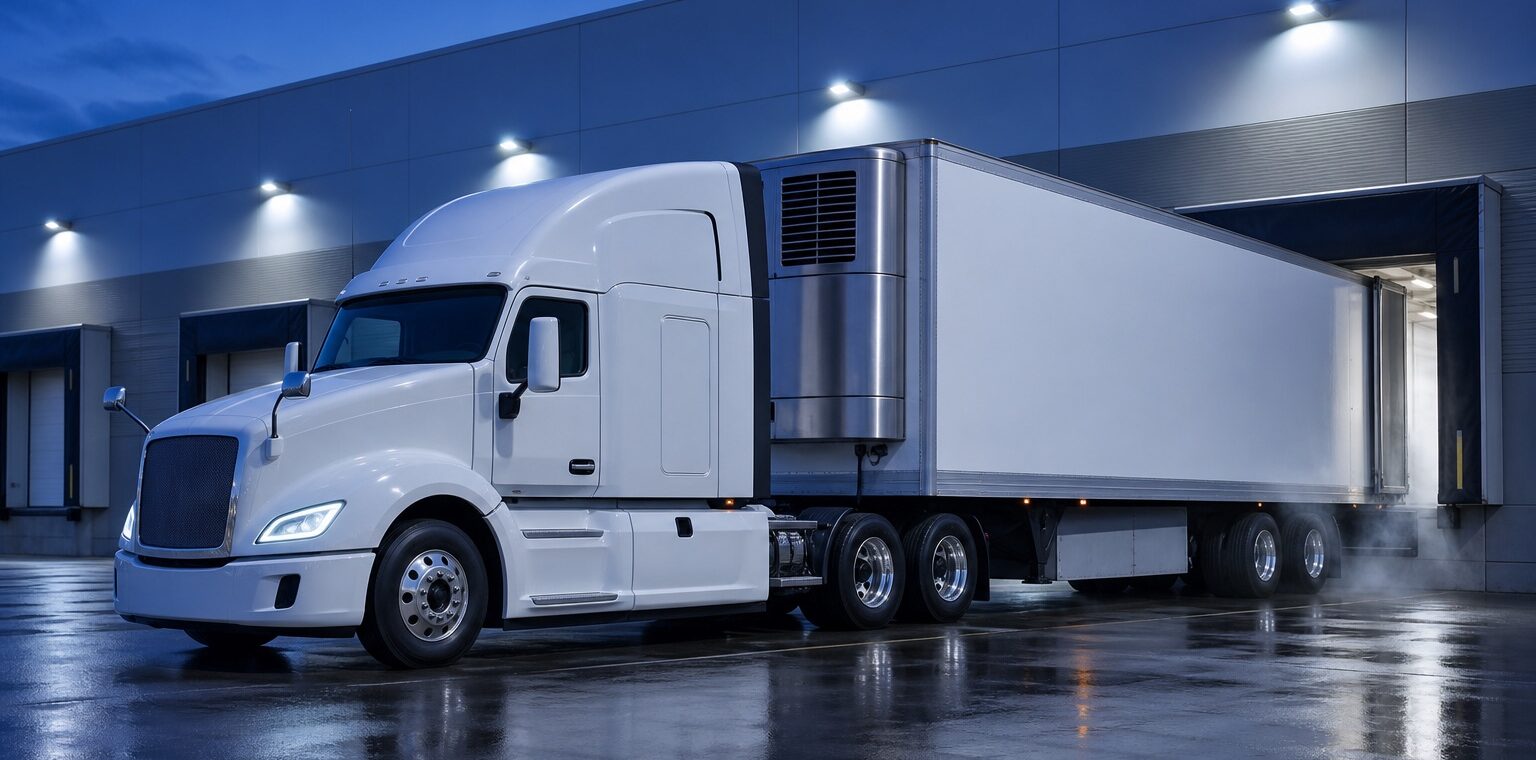
Frozen line-haul is the backbone of the network. Loads move between our own hubs on a published schedule, in trailers we own and maintain, driven by drivers who are trained on cold chain SOP rather than general freight.
How the lane runs
Trailers are pre-cooled to set point before the dock seal is broken. Loading happens through an airlock with the chamber door closed behind it, so the trailer never sees ambient air across an open bay. Set point, door events and fuel level are telemetered back to the dispatch desk every five minutes.
- Pre-cool to −25 °C confirmed before acceptance, logged against the consignment.
- Two independent probes, one in the return air stream and one in the load, so a single sensor failure never blinds the record.
- Fuel floor alarm at 25 %, with a refuel or swap triggered automatically by the desk.
- A spare unit and tractor staged inside every corridor, so a failure means a swap, not a thaw.
What we hold
The contracted band is −25 °C to −18 °C with a control tolerance of ±1.5 °C. Across the trailing twelve months, 0.07 % of logged readings fell outside that band, almost all of them during unavoidable door events at the receiving end.
What breaks it
Two things, in practice. The first is a warm handover at origin: product that has not finished its pull-down arrives at the dock above set point and the trailer spends the first six hours of the run fighting the load instead of holding it. The second is the receiving bay — a dock without a seal turns every delivery into a heat event. We measure both and report them back.
A reefer unit is a maintenance machine, not a refrigeration machine. It holds a temperature it was given. It cannot recover one it was never given in the first place.